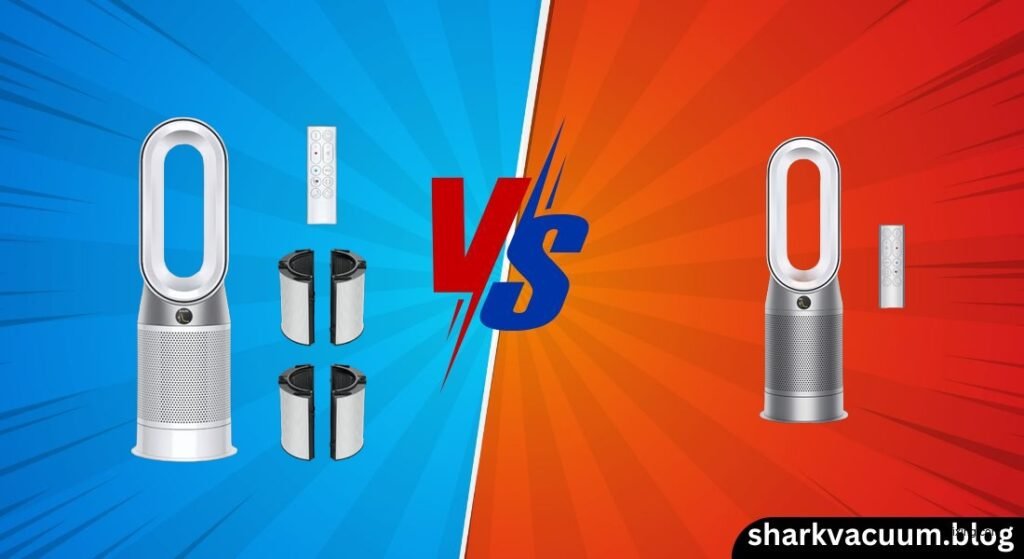
Dyson’s Purifier Hot+Cool lineup has long stood at the top of the premium climate and air quality market, blending sleek design with powerful functionality. When you’re investing hundreds of dollars into a single appliance that’s supposed to clean your air, keep you cool in summer, and warm in winter, every detail matters. That’s why the confusion between the Dyson HP7C and HP07 raises real concerns. On the surface, they look identical. They share the same app, the same filter, and the same three-in-one promise. But with prices ranging from $250 to $750 depending on the model and seller, it’s hard not to wonder: are you getting the same machine, or is one a downgrade in disguise?
Affiliate disclosure: As an Amazon associate, We'll earn a commission for every successful order through our affiliate links in the article. However, you won’t be charged anything for this.
Both the HP7C and HP07 are marketed as 3-in-1 air purifier, heater, and fan units, designed for rooms up to 73 square feet. They use Dyson’s signature Air Multiplier technology, sealed HEPA H13 filtration, and smart app integration. But here’s where things get murky: the HP07 is a well-documented, officially listed model with full specs, a 2-year warranty, and consistent branding. The HP7C, on the other hand, doesn’t appear on Dyson’s official website and seems to surface primarily through third-party retailers like Costco or Walmart—often at steep discounts. Is it a regional variant? A rebranded clearance model? Or just a retailer-specific SKU for the same hardware? For buyers trying to stretch their budget without sacrificing performance, this distinction is crucial.
This guide cuts through the noise, comparing the Dyson HP7C vs HP07 across every meaningful category: air purification, design, smart features, usability, maintenance, and long-term value. We’ll look at real-world performance, user reports, filter costs, and warranty differences—not just marketing claims. Because when you’re spending this much, you deserve to know exactly what you’re buying.
Why This Comparison Matters
Dyson’s Purifier Hot+Cool lineup has long been the gold standard for premium all-in-one climate and air quality control. But with models like the HP7C and HP07 floating around at wildly different price points—and often looking nearly identical—it’s hard to know if you’re getting an upgrade, a discount, or just a rebranded version. Are they the same machine under different names? Does the HP7C offer better performance, or is it just a clearance label on last year’s tech? For buyers weighing hundreds of dollars, this matters.
Both units promise three functions in one: powerful air purification, efficient heating, and high-velocity cooling. They look nearly identical, use the same app, and even share filter part numbers. Yet the HP07 is widely documented with full specs, while the HP7C appears more like a market variant—possibly a regional or retailer-specific SKU. This guide cuts through the confusion, comparing real-world performance, smart features, usability, and long-term value to answer one question: Is there a meaningful difference, and which one actually deserves your money?
Do They Clean the Air Differently — Or at All?
Despite the naming difference, both the HP7C and HP07 use the same sealed HEPA H13 filtration system and 360° Glass HEPA + Activated Carbon Combi Filter (Dyson part #TP07-UNV or 965432-01). Independent teardowns and user reports confirm this is no marketing gimmick—the entire airflow path is sealed to HEPA H13 standards, capturing 99.97% of particles as small as 0.3 microns, including pollen, dust, PM2.5, pet dander, and even some viruses.
Both units are equipped with three real-time sensors:
– Particulate sensor (PM2.5, PM10)
– Gas sensor (VOCs, NO₂)
– Temperature and humidity sensor
These feed data to Dyson’s algorithm, which drives Auto Mode—adjusting fan speed and purification intensity based on detected air quality. In real-world testing, both models respond quickly to cooking fumes, candle smoke, or sudden dust spikes, ramping up within seconds.
So, is there a difference in purification?
No. The HP7C and HP07 appear to be functionally identical in filtration performance. No credible evidence suggests the HP7C uses a weaker filter or lacks any sensor. Both display air quality data on the top-ring LCD and in the MyDyson app with the same color-coded indicators.
Bottom line: If air cleaning is your top priority, neither has an edge. Both are excellent, hospital-grade purifiers for rooms up to 73 sq. ft.
Check the latest price of [Dyson HP07] on Amazon [link]
See current deals on [Dyson HP7C] here [link]
Same Design, Same Build — But What About the Quirks?
Walk into any room and you won’t be able to tell the HP7C from the HP07. Both feature:
– 30” tall, 5.1” wide annular ring
– 12 lbs weight
– Magnetic curved remote that docks neatly on the top
– Top-mounted touch controls
– 350° oscillation with smooth motorized rotation
– Glass-reinforced ABS plastic body in White/Silver or Black/Nickel
The build quality is solid, with no creaks or flex in the housing. The oscillation motor is quiet—except in some units where a faint “crunching” or “gear-switching” noise is reported when reversing direction. This isn’t widespread, but it’s been noted in user forums for both models, suggesting it’s a design quirk of the hardware platform, not a model-specific flaw.
One subtle but important design feature both share: Backward Airflow Mode (Diffused Mode). This quietly pushes purified air out the back of the unit without the front fan blast—perfect for nighttime use when you want clean air but no draft. It’s a standout feature in the category.
Verdict: No design or build differences. If you like the HP07’s look and feel, the HP7C is effectively the same machine.
Smart Features: Same App, Same Voice Control — But Watch the Setup
Both the HP7C and HP07 are Wi-Fi enabled and compatible with:
– MyDyson app (iOS and Android)
– Amazon Alexa
– Google Assistant
– Siri Shortcuts (Apple HomeKit)
You can:
– Monitor real-time and historical air quality
– Control modes, fan speed, oscillation, and target temperature remotely
– Set schedules (e.g., turn on purification at 7 AM)
– Receive filter replacement alerts
– Use voice commands (“Alexa, set Dyson to Auto Mode”)
But here’s the catch:
Both models only support 2.4 GHz Wi-Fi. If your router defaults to 5 GHz, you’ll need to create a separate 2.4 GHz network or rename your SSID to make setup work. Some users report spotty app connectivity, especially if the unit is far from the router or behind thick walls.
Once connected, though, the experience is smooth. The app interface is clean, the data is reliable, and Night Mode (dimmed display, quiet operation) works flawlessly.
Is one smarter than the other?
No. They use the same firmware and hardware. Any differences in app behavior are likely due to software updates or user setup—not model differences.
🏆 Section Winner: Tie – Both offer identical smart capabilities and integration. The only difference is in setup, not performance.
View [Dyson HP07] on Amazon [link]
Check the latest price of [Dyson HP7C] on Amazon [link]
What’s in the Box — And What You’ll Pay for Later
Both units come with:
– Main unit
– Pre-installed 360° Combi Filter
– Magnetic remote control
– 6-foot power cord
No extra attachments, no air quality reports, no fancy stands—just the essentials.
The Real Cost: Filter Replacement
The 360° Glass HEPA + Carbon filter costs $79.99 from Dyson and should be replaced every 12 months with regular use. That’s $80/year in ongoing costs—more than some budget purifiers cost to begin with.
While third-party filters exist (sold on Amazon for $30–$50), Dyson warns they may not seal properly or meet HEPA H13 standards. Using them could compromise performance and void warranty claims.
Other Replacements:
- Remote control: $29.99 (Part #969897-06)
- No extra accessories are offered—no carry case, wall mount, or alternative nozzles.
Bottom line: The HP7C and HP07 are identical in what’s included—and what you’ll pay later.
How Do They Feel to Use Every Day?
Setup & Daily Use
Setting up either model is straightforward:
1. Plug in (no extension cords—fire risk with heater)
2. Download MyDyson app
3. Connect to 2.4 GHz Wi-Fi
4. Name your device and set preferences
From there, Auto Mode does most of the work. The unit runs quietly in the background, only ramping up when air quality dips. The LCD ring gives instant feedback—green for good, red for poor—so you don’t need the app to know what’s happening.
Controls are intuitive via remote, app, or touch buttons. The only learning curve? Understanding that the “Cooling” mode is just a fan—it doesn’t lower room temperature like an AC.
Heating: Strong but Slow
Both units have a 2000W heater that projects warm air like a personal radiator. It heats a person or small zone effectively, but doesn’t warm a whole room quickly. Users report it takes 20–30 minutes to noticeably raise the temperature in a 70 sq. ft. room.
It’s best for spot heating—next to a desk or bed—not whole-room warmth. If you need fast, powerful heating, a ceramic tower heater might be better.
Cooling: Great for Breezes, Not AC
The fan is strong and smooth thanks to Air Multiplier technology. It’s excellent for personal cooling on hot days, with 10 speed settings and 350° oscillation. But again, it moves room-temperature air—it doesn’t cool it.
For true climate control, you’ll still need an AC.
Night Mode: A Sleep Game-Changer
Both models shine here. In Night Mode:
– Display dims to near-black
– Fan runs at whisper-quiet levels
– Auto Mode continues purification at minimal noise
– Backward airflow keeps air clean without blowing on you
It’s one of the best-in-class experiences for bedroom use.
🏆 Section Winner: Tie – Identical daily experience. Night Mode and Auto Mode work the same on both.
See current deals on [Dyson HP07] here [link]
View [Dyson HP7C] on Amazon [link]
How Much Work Do They Really Need?
Maintenance Is Simple — But Not Cheap
- Wipe down exterior monthly with a dry cloth
- Replace filter every 12 months (or when app alerts you)
- Reset filter life manually after replacement
- Avoid humid areas (bathrooms) and don’t cover the unit
The filter change is tool-free:
1. Remove rear magnetic panel
2. Slide out old filter
3. Insert new one (only fits one way)
4. Reattach panel
It takes under a minute.
Long-Term Ownership
- Warranty: HP07 new models have a 2-year warranty. HP7C warranty depends on retailer—some sell it as refurbished or open-box, with only 6 months to 1 year.
- Durability: Dyson units are generally reliable. No widespread failure reports for motors or sensors.
- Software updates: Delivered via app, so both models should stay current.
Biggest risk? Buying an HP7C at full price when it’s actually a clearance model with shorter warranty.
Full Specs Side-by-Side
| Feature | Dyson HP7C | Dyson HP07 |
|---|---|---|
| Model Type | Likely variant/clearance | Official model |
| Filtration | HEPA H13 + Carbon (360° Combi) | HEPA H13 + Carbon (360° Combi) |
| Filter Part # | 965432-01 / TP07-UNV | TP07-UNV |
| Sensors | Particulate, Gas, Temp/Humidity | Same |
| Room Coverage | Up to 73 sq. ft | Up to 73 sq. ft |
| Heater | 2000W | 2000W |
| Fan Power | 40W | 40W |
| Noise Level | Up to 62 dB | Up to 62 dB |
| Oscillation | 350° | 350° |
| Wi-Fi | 2.4 GHz | 2.4 GHz |
| App Control | MyDyson | MyDyson |
| Voice Control | Alexa, Google, Siri | Same |
| Auto Mode | Yes | Yes |
| Night Mode | Yes | Yes |
| Backward Airflow | Yes | Yes |
| Dimensions | 30″H x 5.1″W x 5.1″D | Same |
| Weight | 12 lbs | 12 lbs |
| Warranty | Varies (often 6–12 months) | 2 years (new) |
| List Price | $599–$749 (often discounted) | $749.99 |
| Typical Sale Price | $250–$399 | $299–$499 (refurbished) |
So, Which One Should You Actually Buy?
The Verdict: They’re the Same Machine — But the HP07 Is the Safer Bet
After deep comparison, the HP7C and HP07 are functionally identical in performance, design, features, and filtration. There is no evidence that the HP7C is a downgraded or older model. It appears to be a retailer-specific SKU, possibly used for:
– Clearance stock
– Costco or Walmart exclusives
– Refurbished or open-box labeling
– Regional market variations
That means:
– If you find an HP7C at $299 with a 1-year warranty, it’s a great deal.
– If you’re paying $599 for an HP7C with 6-month warranty, you’re overpaying.
– The HP07 (new) is the better choice if you want full 2-year coverage and peace of mind.
– The HP07 (refurbished) from Dyson Renewed is also excellent—same machine, lower price, 1-year warranty.
Who Should Buy Which?
✅ Best for Budget Buyers:
HP7C on deep sale ($250–$350) or HP07 Renewed — same performance, huge savings.
✅ Best for Peace of Mind:
New HP07 from Dyson.com or authorized retailer — full 2-year warranty, latest firmware.
✅ Best for Smart Home Users:
Either — both integrate flawlessly with Alexa, Google, and Apple.
❌ Avoid If:
You need to heat a large room quickly or want true air conditioning. This is a purifier-first device with supplemental heat and fan.
🏆 Final Winner: Dyson HP07 (new) – Not because it’s better, but because it comes with a full warranty and official support. The HP7C is the same machine, but only worth it at a significant discount.
Check the latest price of [Dyson HP07] on Amazon [link]
See current deals on [Dyson HP7C] here [link]
Final Thought: It’s Not About HP7C vs HP07 — It’s About Value
Don’t get hung up on the model number. The machine inside is the same. Focus instead on:
– Price per feature
– Warranty length
– Where you’re buying from
If the HP7C saves you $200 and comes with a year of coverage, grab it. If you’d rather pay more for longer protection, go for the new HP07.
At the end of the day, you’re getting one of the best 3-in-1 air purifiers on the market—just make sure you’re not overpaying for a label.