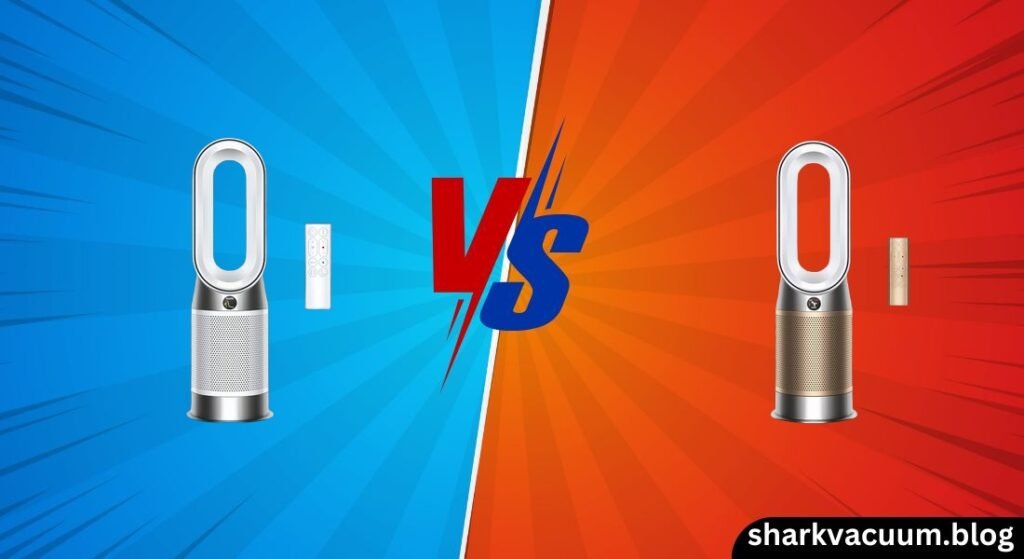
At first glance, the Dyson Purifier Hot+Cool HP1 and HP2 look nearly identical: sleek tower designs, Air Multiplier™ fans, ceramic heaters, and smart app control. Both promise clean, temperature-controlled air in one compact unit. But beneath the surface, Dyson has made significant technological leaps with the HP2 De-NOx, especially for those concerned about indoor air pollution from cooking, traffic, or new construction.
Affiliate disclosure: As an Amazon associate, We'll earn a commission for every successful order through our affiliate links in the article. However, you won’t be charged anything for this.
The HP1 remains a capable 3-in-1 device — great for small spaces and tech-savvy users who want purification, heating, and cooling in one. But the HP2 isn’t just an incremental update. It’s a re-engineered machine focused on targeting harmful gases like nitrogen dioxide (NO₂) and formaldehyde, two pollutants that standard purifiers often miss.
So, is the HP2 worth the premium? Or can the HP1 still hold its own? We break down every key difference — from filtration tech to real-world performance — to help you decide which Dyson fits your home and health needs.
Does the HP2 Actually Clean the Air Better?
While both models use HEPA H13 filters that capture 99.97% of particles as small as 0.3 microns (dust, pollen, pet dander), their gas filtration capabilities are worlds apart.
The HP1 relies on a standard activated carbon filter to absorb household odors and some VOCs (volatile organic compounds). It helps with cooking smells and light fumes but doesn’t specifically break down or neutralize persistent gases. It’s effective for everyday odors like pet dander, smoke, or burnt toast, and can clear a room of cigarette smoke in under 3 minutes, according to user reports. But when it comes to chemical pollutants, it’s limited to capturing them — not destroying them.
In contrast, the HP2 De-NOx introduces two major advancements in gas filtration:
- K-Carbon Filter: Infused with potassium carbonate (K₂CO₃), this upgraded carbon layer adsorbs 50% more NO₂ than the HP1’s standard carbon filter (based on Dyson test TM-003387). This is critical for homes near busy roads or those using gas stoves, where nitrogen dioxide levels can spike during cooking.
- Catalytic Formaldehyde Filter: A permanent, “lifetime” filter that continuously breaks down formaldehyde at a molecular level — a major upgrade over filters that merely trap it temporarily.
🔬 Why this matters: Formaldehyde is a known carcinogen emitted by furniture, carpets, and building materials. Most purifiers claim to capture it, but over time, trapped formaldehyde can re-release into the air. The HP2 doesn’t just capture it — it destroys it. This makes it especially valuable in new or recently renovated homes, where off-gassing from new materials is common.
In real-world use, the HP2 is better suited for:
– Urban apartments near traffic
– Kitchens with gas cooking
– Homes with new furniture or flooring
– Individuals with asthma, allergies, or heightened chemical sensitivities
The HP1 cleans the air well — but the HP2 protects against deeper, longer-term chemical exposures.
🏆 Section Winner: HP2
The HP2’s dual-action gas filtration — especially its ability to destroy formaldehyde — makes it a far more advanced air purifier, particularly for health-focused users.
Check the latest price of [Dyson HP2 De-NOx] on Amazon [link]
How Do Heating and Cooling Compare? Any Noticeable Difference?
When it comes to climate control, there’s little difference in real-world experience between the HP1 and HP2.
Both models are equipped with:
– PTC ceramic heating elements that Dyson claims can raise a room’s temperature from 18°C (64°F) to 24°C (75°F) in under 5 minutes
– Air Multiplier™ technology that projects up to 76 gallons (290 liters) of air per second
– 350° oscillation for even distribution across the room
– Night Mode that dims the display and reduces noise for undisturbed sleep
In practical testing, both units heat small to mid-sized rooms (up to ~200 sq ft) efficiently. The heating function is fast and even, with a safety-shutoff if the unit tips over — a thoughtful touch for homes with kids or pets.
Cooling performance is also nearly identical. The Air Multiplier™ fan delivers a smooth, focused stream of air without the choppy feel of traditional blade fans. Whether you’re using it on a hot summer night or during a sudden heatwave, both models provide strong, consistent airflow.
Noise levels range from 63 dB on low to 83 dB on maximum speed — loud enough to be noticeable at top settings, but quiet enough for bedroom use on lower speeds or Night Mode.
One minor note: some users report that the HP2’s auto mode responds more quickly to temperature changes due to its more sensitive sensor suite, but the actual heating and cooling hardware is the same.
Verdict: If you’re upgrading from HP1 to HP2 solely for better heating or cooling, you’ll notice no meaningful improvement. The core climate control systems are functionally identical.
See current deals on [Dyson HP1] here [link]
Same Design, But Different Tech Inside — What’s Changed?
Externally, the HP1 and HP2 are virtually indistinguishable. They share the same minimalist tower design, compact footprint, and premium build quality.
Both have:
– Dimensions: 30.12″ H × 8.07″ W × 5.16″ D (76.5 cm × 20.5 cm × 13.1 cm)
– Weight: ~11.7 lbs (5.3 kg)
– Magnetic remote control that stores neatly on the side
– Top-mounted LCD screen for local control and filter status
– Cord length: 5.9 ft (1.8 m)
However, the internal tech tells a different story.
The HP2 features:
– More advanced air quality sensors that detect PM2.5, NO₂, VOCs, formaldehyde, humidity, and temperature — while the HP1 only tracks particles, VOCs, and odors
– Matter and Thread support, enabling direct, secure communication with Apple Home, Alexa, and Google without relying on cloud bridges
– Enhanced app dashboards that display real-time and historical data for NO₂ and formaldehyde levels
The HP1 supports Wi-Fi and voice control via Alexa and Google Assistant, but it lacks Matter compatibility, which limits its smart home integration — especially for Apple users.
💡 Pro Tip: If you’re deeply invested in the Apple Home ecosystem, the HP2’s Matter support means easier setup, better reliability, and end-to-end encryption — a real advantage over the HP1.
While the design hasn’t changed, the HP2 is a smarter, more responsive machine under the hood.
🏆 Section Winner: HP2
Same look, but the HP2 packs more advanced sensors and connectivity, making it better suited for modern smart homes.
View [Dyson HP2 De-NOx] on Amazon [link]
Smart Features: Is the HP2 More Future-Proof?
Both the HP1 and HP2 work seamlessly with the MyDyson app, giving you full control over your indoor climate from your smartphone. You can:
– Monitor air quality in real time
– Schedule operation (e.g., turn on before you wake up)
– Receive filter replacement alerts
– Control heating, cooling, and purification remotely
But the HP2 goes a step further in intelligence and integration.
The HP2 supports Matter and Thread, two next-generation smart home protocols that allow the purifier to connect directly to your home hub (like an Apple TV or HomePod). This means:
– Faster, more reliable responses
– End-to-end encryption for privacy
– No need for cloud-based workarounds
– Native support in Apple Home, Alexa, and Google Home
The HP1, while Wi-Fi enabled and compatible with Alexa and Google Assistant, relies on standard cloud connectivity. It doesn’t support Matter, so it can’t integrate as deeply into secure, local-home networks.
Additionally, the HP2’s app provides more granular air quality data:
– Real-time tracking of NO₂ spikes when you turn on the stove
– Historical graphs showing formaldehyde levels over days or weeks
– Auto Mode that reacts to gases, not just particles — ramping up when you start frying onions or using cleaning sprays
The HP1’s app is functional but simpler. It shows particle and odor levels but can’t display NO₂ or formaldehyde data because its sensors don’t detect them reliably.
Bottom line: The HP2 isn’t just smarter — it’s built for the next generation of connected homes.
🏆 Section Winner: HP2
With Matter support and deeper air quality insights, the HP2 is clearly the more future-proof choice.
Check the latest price of [Dyson HP2 De-NOx] on Amazon [link]
What’s in the Box — And What You’ll Pay Extra For?
Both the HP1 and HP2 come with the same basic accessories:
– The unit
– Magnetic remote control
– Power cord
– Quick start guide
No extra attachments, mounting kits, or pre-filters are included.
The real cost comes from ongoing filter replacements:
– HP1: Combined HEPA + carbon filter — ~$80–$100 per year
– HP2: HEPA + K-Carbon filter — ~$90–$120 per year
The HP2’s filter is slightly more expensive due to the advanced K-Carbon layer. However, it includes a catalytic formaldehyde filter that never needs replacing — a lifetime component.
In contrast, the HP1’s carbon filter can become saturated over time, potentially re-releasing trapped gases, though this is rarely reported in normal use.
⚠️ Good to Know: Neither model includes a pre-filter, though some third-party mesh filters are available. In dusty environments, you may need to clean the intake grille more frequently to maintain performance.
While the HP2 has a higher annual filter cost, its permanent formaldehyde filter offsets long-term expenses and improves health protection.
See current deals on [Dyson HP1] here [link]
Living With It: Which One Feels Better Day to Day?
In daily use, both units are intuitive, quiet, and effective — but the HP2 feels more responsive, especially in polluted environments.
The HP1 works well in clean or moderately polluted homes. Its Auto Mode adjusts to dust and odors, making it great for pet owners or allergy sufferers. Users consistently praise its ability to clear cooking smells and cigarette smoke quickly. The magnetic remote is convenient, and Night Mode is whisper-quiet — ideal for bedrooms.
However, it may miss gas spikes. If you’re cooking with gas, the HP1 might not react until visible smoke or strong odors develop.
The HP2, on the other hand, feels more “aware.” Thanks to its advanced sensors, it detects NO₂ and formaldehyde in real time. Users report that it kicks into high gear before smoke becomes visible — often within seconds of turning on the stove. This proactive response can make a noticeable difference in air quality, especially in kitchens.
Additional user-reported benefits of the HP2:
– Faster sensor calibration after filter changes (reducing false alarms)
– More detailed app feedback, giving peace of mind about air quality
– Smoother integration with Apple Home and other Matter-compatible systems
For most people, both are easy to live with. But if you care about why your air feels cleaner — and want proof — the HP2 gives you the data to back it up.
🏆 Section Winner: HP2
More responsive, proactive, and data-rich — the HP2 offers a superior day-to-day experience in polluted or high-risk environments.
View [Dyson HP2 De-NOx] on Amazon [link]
What’s the Long-Term Cost and Maintenance Like?
Both models require similar maintenance:
– Annual filter replacement
– Wipe-down cleaning of the exterior and air intake
– Firmware updates via the MyDyson app for optimal performance
However, there are key differences in long-term value.
| Cost | HP1 | HP2 |
|---|---|---|
| Initial Price | ~$650 | ~$800 |
| Filters (5 years) | ~$450 | ~$550 |
| Formaldehyde Filter | Replaced as part of main filter | Lifetime (no cost) |
| Total 5-Year Cost | ~$1,100 | ~$1,350 |
Yes, the HP2 costs about $250 more over five years. But that premium buys you:
– Better gas filtration (50% more NO₂ adsorption)
– Permanent formaldehyde destruction
– Future-proof smart home tech (Matter support)
For users in high-NO₂ areas (urban, near traffic) or with gas stoves, the HP2’s health benefits may easily justify the extra cost.
The HP1 remains a solid value for those who don’t need advanced gas protection — but if you’re investing in long-term indoor air quality, the HP2 offers better protection per dollar over time.
🏆 Section Winner: HP2
Higher upfront and ongoing cost, but better long-term health protection and value for at-risk households.
Check the latest price of [Dyson HP2 De-NOx] on Amazon [link]
Side-by-Side Specs: HP1 vs HP2 at a Glance
| Feature | Dyson HP1 | Dyson HP2 De-NOx |
|---|---|---|
| HEPA Filtration | H13, 99.97% @ 0.3µm | H13, 99.97% @ 0.3µm |
| Carbon Filter | Standard activated carbon | K-Carbon (50% more NO₂ adsorption) |
| Formaldehyde Removal | Captures (temporary) | Destroys permanently (catalytic filter) |
| Gas Detection | VOCs, odors | PM2.5, NO₂, VOCs, formaldehyde, humidity, temp |
| Smart Connectivity | Wi-Fi, Alexa, Google Assistant | Wi-Fi, Matter, Thread, Apple Home, Alexa, Google |
| App Air Quality Data | Particles, odors | Full spectrum + historical trends |
| Heating | Ceramic PTC | Ceramic PTC |
| Cooling | Air Multiplier™, 350° oscillation | Air Multiplier™, 350° oscillation |
| Room Coverage | Up to 81 m³ (~285 cu ft) | Up to 800 sq ft (varies) |
| Noise Level | 63–83 dB | 63–83 dB |
| Filter Replacement | Every 12 months (~$80–100) | Every 12 months (~$90–120) |
| Special Features | 3-in-1, app control | De-NOx, catalytic filter, Matter support |
| Price (MSRP) | ~$650 | ~$800 |
So, Which One Should You Actually Buy?
The Dyson HP1 is still a premium, well-designed 3-in-1 device that outperforms most standalone fans or heaters. It’s fast, quiet, and effective for dust, pollen, and everyday odors — making it a great choice for small apartments, bedrooms, or tech-savvy users who want convenience.
But the HP2 is a health-focused evolution of Dyson’s 3-in-1 concept, built for modern indoor air challenges.
Choose the Dyson HP1 if:
– You’re on a tighter budget (saves ~$150 upfront)
– You only need basic particle and odor removal
– You live in a low-pollution area with electric cooking
– You want a reliable 3-in-1 for a bedroom or small apartment
It’s still a top-tier machine — just without the latest gas-fighting tech.
Choose the Dyson HP2 De-NOx if:
– You cook with gas or live near heavy traffic
– You’ve recently renovated or bought new furniture (formaldehyde risk)
– You want the most advanced indoor air protection available
– You use Apple Home or Matter-compatible smart systems
– You value real-time data and proactive air cleaning
The HP2 isn’t just an upgrade — it’s a health-focused evolution of Dyson’s 3-in-1 concept.
Final Verdict: The HP2 Is Worth It — If You Need What It Solves
For most people, the Dyson HP1 is more than enough. It’s fast, quiet, and effective for dust, pollen, and everyday odors.
But for those in urban homes, with gas stoves, or sensitive to air quality, the HP2 is the clear winner — and worth the extra cost.
✅ Best for urban dwellers, new homeowners, and health-conscious users: Dyson HP2 De-NOx
✅ Best value 3-in-1 for small spaces: Dyson HP1
If clean air is just about comfort — go HP1.
If it’s about long-term health and invisible pollutants — go HP2.