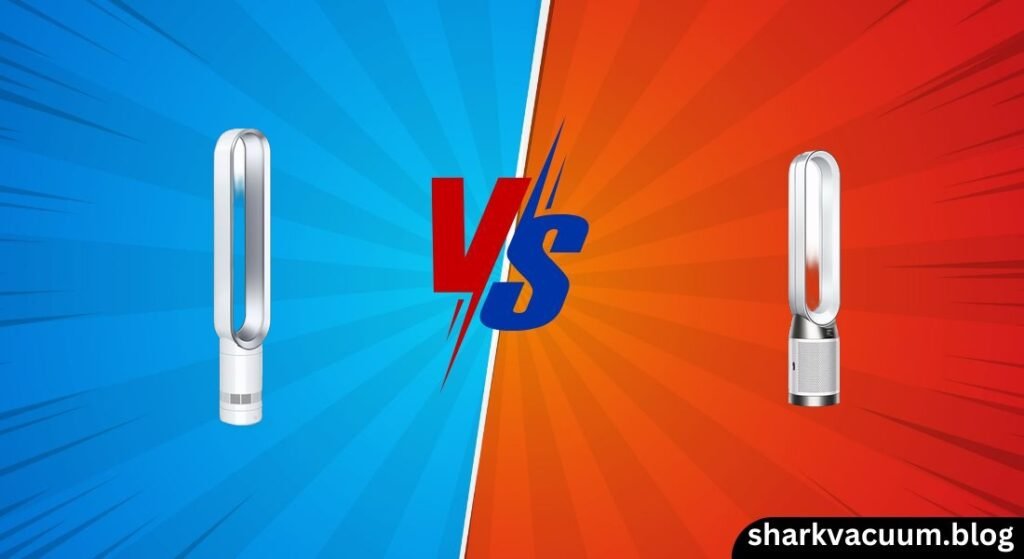
With rising concerns about indoor air quality and energy-efficient cooling, Dyson’s AM07 and TP10 represent two very different approaches to climate control in the home. The AM07 is a pure bladeless fan focused on smooth, quiet airflow—ideal for summer relief. The TP10, meanwhile, is an air purifier with cooling functionality, designed to clean your air and circulate it. But which one actually fits your needs better? Is the extra cost of the TP10 justified by its filtration? Or is the AM07 still the smarter buy if all you want is powerful, modern cooling?
Affiliate disclosure: As an Amazon associate, We'll earn a commission for every successful order through our affiliate links in the article. However, you won’t be charged anything for this.
We dive deep into performance, design, usability, and long-term value to help you decide: Should you upgrade to a purifier-fan hybrid, or stick with Dyson’s classic cooling tech? If you’re weighing the Dyson AM07 vs TP10, this side-by-side breakdown will clarify exactly what each model offers—and what you’re really paying for.
Why This Comparison Matters Right Now
More than ever, people are paying attention to what’s in their indoor air. Allergens, pollution, pet dander, and cooking fumes can linger in homes, especially in cities or during wildfire season. At the same time, energy efficiency and quiet operation matter—especially in bedrooms or shared living spaces. The Dyson AM07 and TP10 sit at opposite ends of this spectrum: one prioritizes pure cooling performance, the other air quality intelligence.
The AM07 doesn’t filter anything—it moves air with impressive power and silence. The TP10, on the other hand, is built like a health appliance: it senses pollutants, filters them out, and adjusts itself automatically. But it doesn’t blow air as hard. So the real question isn’t which is “better”—it’s which one aligns with your priorities. Are you looking for relief from heat, or relief from allergies and odors? This guide breaks down every difference so you can choose with confidence.
Check the latest price of [Dyson AM07] on Amazon [link]
See current deals on [Dyson TP10] here [link]
Does the TP10 Actually Clean the Air—Or Just Move It?
Let’s cut through the marketing: the TP10 isn’t just a fan. It’s a true air purifier with medical-grade HEPA H13 filtration.
- HEPA H13 Filter: Captures 99.95% of particles as small as 0.1 microns—including PM2.5, pollen, dust mites, pet dander, mold spores, and even some viruses (like H1N1).
- Sealed System: Unlike many purifiers, Dyson ensures the entire airflow path is sealed to H13 standard, so no dirty air leaks around the filter.
- Activated Carbon Layer: Removes VOCs, cooking odors, smoke, and gases—though it doesn’t destroy formaldehyde like newer models (TP09+).
- Real-Time Monitoring: Built-in sensors track PM2.5, PM10, VOCs, and allergens, with an LCD display showing air quality in real time.
In contrast, the AM07 does zero air cleaning. It circulates air—efficiently, quietly, and widely—but it doesn’t filter anything. If you care about allergens, pollution, or indoor air safety, the TP10 wins by default.
The TP10 pulls in air from 360° around its base, forces it through a 360° Glass HEPA H13 filter made of borosilicate microfibers, then adds an activated carbon layer to trap gases and odors. The entire machine is sealed to prevent unfiltered air from escaping—something many cheaper purifiers fail at. Independent testing confirms it meets EN1822 and ISO29463 standards for HEPA efficiency.
Meanwhile, the AM07 simply uses Dyson’s Air Multiplier™ tech to draw in air and project it forward—no filtration involved. It’s excellent at moving air, but it won’t reduce dust or allergens.
Pro Tip: If you have asthma, pets, or live in a high-pollution area, the TP10’s filtration is not just a bonus—it’s a necessity.
Bottom line: The TP10 is a real purifier. The AM07 is just a fan.
View [Dyson TP10] on Amazon [link]
Which One Cools Better: Raw Airflow vs Smart Circulation
When it comes to moving air, both use Dyson’s Air Multiplier™ technology, but they serve different purposes.
AM07: Maximum Airflow for Large Rooms
- Airflow Output: Up to 500 liters per second
- Projection: 132 gallons (≈500L) per second, with smooth amplification via Coanda effect
- Oscillation: 70° side-to-side
- Room Coverage: Designed for spaces up to 550 sq ft
- Speed Settings: 10 precise levels
Users report strong, consistent airflow—ideal for open-plan living rooms or large bedrooms. It’s especially effective at displacing hot air during summer. The AM07 uses a brushless motor with 11 asymmetric blades to generate high-pressure airflow, which is then amplified over an airfoil-shaped ramp. This creates a powerful, uninterrupted stream of air—35% quieter than earlier Dyson models.
With a 35 dB noise level, it’s barely audible on low settings, making it great for light sleepers. Its 70° oscillation covers a wide arc, though not as wide as the TP10’s.
TP10: Purified Airflow at Lower Volume
- Airflow Output: 290 liters per second (max)
- Oscillation: 350°—much wider than AM07
- Coverage: Rated for 27m² (≈291 sq ft)
- Speed Settings: Also 10 levels, plus Auto Mode that adjusts based on air quality
While the TP10 moves less air than the AM07, its 350° oscillation gives it broader reach in smaller rooms. And in Auto Mode, it ramps up when pollutants spike—ideal for kitchens or pet areas. The fan speed adjusts automatically based on real-time sensor data, so it’s not just cooling—it’s responding to your environment.
However, the airflow is noticeably gentler. This makes sense: the TP10 is designed for air turnover and purification, not brute-force cooling. In a large living room, it may struggle to create a strong breeze.
Winner for raw cooling power: AM07
Winner for smart, targeted air movement: TP10
Good to Know: The AM07’s airflow is nearly 72% stronger than the TP10’s. If you want that “wind tunnel” feel, the AM07 delivers.
Check the latest price of [Dyson AM07] on Amazon [link]
Same Brand, Very Different Feel
Dyson fans are known for their minimalist aesthetic, but the AM07 and TP10 have distinct design philosophies.
AM07: Sleek, Minimalist Tower
- Height: 39.6 inches (1006mm)
- Base Diameter: 7.5 inches
- Weight: 6.3 lbs (2.86kg) — lightweight and easy to move
- Materials: Polished plastic with metal-like finish (Satin Black/Nickel, White/Silver, Iron/Blue)
- Remote: Magnetic curved remote stored on top
It’s tall, narrow, and blends into corners. The bladeless ring is iconic—safe for kids and pets. The AM07 looks like a modern sculpture: clean lines, no visible grilles, and a sleek profile that disappears into the background. Its lightweight build makes it easy to carry from room to room.
TP10: Sturdy, Tech-Forward Purifier
- Height: 41.34 inches (1050mm) — slightly taller
- Footprint: 8.66″ x 8.66″ — wider base
- Weight: ~10.4 lbs (4.73kg) — feels more substantial
- Front Panel: Includes LCD screen showing air quality, filter life, and mode
- Color Options: White/White, White/Silver
The TP10 looks more like a tech appliance than a fan. The LCD display adds function but breaks the minimalist magic. It’s bulkier, heavier, and clearly built for permanence. You’re meant to leave it in one room and let it monitor the air 24/7.
While both have magnetic remotes (a Dyson hallmark), the TP10’s remote includes additional buttons for air quality mode, filter status, and night mode.
Design takeaway: AM07 wins on elegance; TP10 wins on utility.
Pro Tip: If you value interior design, the AM07 is the more discreet choice. If you want constant feedback on your air quality, the TP10’s screen is invaluable.
View [Dyson TP10] on Amazon [link]
What Can Each One Do That the Other Can’t?
Let’s break down the unique features.
TP10-Only Features:
- ✅ Real-time air quality monitoring (PM2.5, VOCs, gases)
- ✅ HEPA + carbon filtration (removes allergens, odors, smoke)
- ✅ Auto Mode – fan adjusts based on air quality
- ✅ Filter life indicator (12-month lifespan)
- ✅ Night Mode with dimmed display and <50dB operation
The TP10 actively monitors your environment. If someone fries fish in the kitchen, it detects the VOC spike and ramps up. If pollen counts rise in spring, it increases filtration. This adaptive intelligence is absent in the AM07.
AM07-Only Features:
- ✅ Higher max airflow (500L/s vs 290L/s)
- ✅ 35dB noise level — quieter than TP10 even at low speeds
- ✅ No consumables — no filter to replace
- ✅ Lighter, more portable
The AM07 is simpler, more efficient, and requires zero maintenance. No sensors, no filters, no updates—just plug in and enjoy powerful, whisper-quiet airflow.
Key insight: The TP10 trades peak performance for intelligence and health benefits.
🏆 Section Winner: TP10 – for offering features that actively improve indoor air quality and reduce allergens.
See current deals on [Dyson TP10] here [link]
What’s in the Box—and What You’ll Pay Extra For
AM07 Includes:
- Fan unit
- Magnetic remote (CR2032 battery included)
Nothing else needed. No filters, no apps, no subscriptions. It’s a complete, self-contained cooling solution.
TP10 Includes:
- Purifier-fan unit
- Pre-installed 360° Glass HEPA + Carbon filter
- Magnetic remote
- Quick start guide
But you will pay extra later:
– Filter replacement: ~Rp 1,055,000 (~$70 USD) every 12 months (with 12 hrs/day use)
– No app or voice control — unlike newer TP09/TP10 successors
The TP10 lacks Wi-Fi, so you can’t control it from your phone or integrate it with Alexa/Google Assistant. This is a Gen1 limitation—newer models offer app support, but the TP10 does not.
Hidden cost alert: The TP10’s lifetime cost is higher due to filter replacements. Over five years, that’s $350+ in filters alone—enough to buy a second AM07.
Good to Know: Some retailers offer a free filter with purchase (valued at ~$70), but this is a one-time perk.
🏆 Section Winner: AM07 – for lower long-term ownership cost and no recurring expenses.
Check the latest price of [Dyson AM07] on Amazon [link]
How Easy Are They to Live With Every Day?
Setup & Controls
- AM07: Plug in, use remote. No learning curve.
- TP10: Slightly more complex—turn on, check air quality, choose mode. LCD takes a second to understand.
Both use magnetic remotes—a Dyson signature that prevents loss. The AM07’s remote is simpler: just power, speed, oscillation, and timer. The TP10’s adds mode selection (Auto, Night), filter reset, and air quality display.
Daily Use Scenarios
- Sleeping? AM07 is quieter (35dB), but TP10 has Night Mode with auto-dimming and low noise (<50dB).
- Cooking? TP10 detects smoke/VOCs and ramps up automatically. AM07 just blows air.
- Allergies? Only TP10 helps—removes pollen, dust, pet dander.
- Large room? AM07’s stronger airflow wins.
- Small bedroom or office? TP10’s smart features shine.
The TP10 is better for homes where air quality fluctuates—like those with pets, smokers, or urban pollution. The AM07 excels in stable environments where you just want cool air.
Verdict: TP10 is smarter. AM07 is simpler.
Pro Tip: If you hate fiddling with settings, the AM07 is “set and forget.” If you like data and automation, the TP10 will feel worth the complexity.
View [Dyson TP10] on Amazon [link]
Keeping It Running: Maintenance Reality Check
AM07: Nearly Zero Maintenance
- Wipe down with a damp cloth
- No blades to clean
- No filters to replace
- No software updates
- True “set and forget”
You’ll never need to buy a part for the AM07. Just dust it occasionally.
TP10: Regular Upkeep Required
- Filter replacement every 12 months (~$70)
- Filter life indicator on LCD reminds you
- Exterior cleaning recommended (especially intake grilles)
- No firmware updates or app support (Gen1 limitation)
While the filter change is simple—just pop open the base and swap it—the cost adds up. And unlike newer Dyson purifiers, you can’t track filter life via an app.
Long-term ownership: AM07 wins on hassle-free operation.
🏆 Section Winner: AM07 – for being truly maintenance-free.
See current deals on [Dyson AM07] here [link]
Side-by-Side Specs: Everything Compared
| Feature | Dyson AM07 | Dyson TP10 |
|---|---|---|
| Type | Bladeless Fan | Air Purifier + Fan |
| Airflow | 500 L/s | 290 L/s (max) |
| Coverage | Up to 550 sq ft | Up to 291 sq ft |
| Filtration | None | HEPA H13 + Carbon |
| Particle Removal | ❌ | ✅ 99.95% @ 0.1µm |
| Odor/Gas Removal | ❌ | ✅ (VOCs, cooking smells) |
| Sensors | ❌ | ✅ PM2.5, PM10, VOCs |
| LCD Display | ❌ | ✅ Real-time air quality |
| Auto Mode | ❌ | ✅ Adjusts to air quality |
| Night Mode | ✅ (quiet setting) | ✅ (<50dB, dimmed display) |
| Oscillation | 70° | 350° |
| Speed Settings | 10 | 10 + Auto |
| Noise Level | 35 dB | <50 dB (Night Mode) |
| Power Use | 56W | 30–60W |
| Weight | 6.3 lbs (2.86kg) | 10.4 lbs (4.73kg) |
| Remote | ✅ (magnetic) | ✅ (magnetic) |
| App Control | ❌ | ❌ (Gen1 limitation) |
| Voice Control | ❌ | ❌ |
| Filter Replacement Cost | N/A | ~$70 every 12 months |
| Warranty | 2 years (assumed) | 2 years |
| Price (USD equivalent) | ~$270 | ~$370 (after discount) |
Key Takeaway: The TP10 does more, but the AM07 does cooling better.
So, Which One Should You Actually Buy?
✅ Buy the Dyson AM07 if you…
- Just want powerful, quiet cooling
- Live in a large room or open space
- Prefer zero maintenance and no recurring costs
- Love the Dyson design but don’t care about air quality
- Are on a tighter budget (cheaper upfront)
✅ Buy the Dyson TP10 if you…
- Care about allergies, pets, or air pollution
- Want real-time air quality feedback
- Need odor and smoke removal (e.g., cooking, smoking)
- Live in a city with high PM2.5 levels
- Value smart, automatic operation
- Don’t mind paying ~$70/year for filter replacements
Real Talk: If you don’t have allergies or air quality concerns, the TP10’s extra features won’t matter. But if you do, the AM07 won’t help you.
The Final Verdict
The Dyson AM07 is still one of the best pure bladeless fans ever made—efficient, quiet, and elegant. But the TP10 represents the future: a smart, health-focused appliance that does more than just cool.
Overall Winner: Dyson TP10 — but only if you need air purification.
If air quality matters to you, the TP10 is worth the extra cost and maintenance. But if you just want a great fan with no strings attached, the AM07 remains a classic—and a better value for pure cooling.
Final Recommendation by Use Case
| Need | Best Pick |
|---|---|
| Best for large rooms | AM07 |
| Best for allergies/asthma | TP10 |
| Best for low maintenance | AM07 |
| Best for urban apartments (pollution) | TP10 |
| Best for quiet sleep | AM07 (quieter), but TP10 has Night Mode |
| Best long-term value | AM07 |
| Best smart features | TP10 |
| Best for pet owners | TP10 (removes dander) |
Bottom line: It’s not about which is better—it’s about what you need.
Cooling only? AM07.
Clean and cool? TP10.