Dyson’s first-generation air purifiers—the HP10 and TP10—may no longer be the newest models on the block, but they’re still very much in the conversation, especially as certified refurbished units pop up at tempting discounts. With newer Dyson models like the PC1 and HP07 dominating headlines, you might wonder: Is the older TP10 still a smart buy? Or is the HP10 worth the extra cost for its heating feature? Both promise hospital-grade HEPA H13 filtration, real-time air quality monitoring, and Dyson’s signature Air Multiplier™ technology. But beyond the specs, there are real differences in performance, long-term value, and daily use that could sway your decision. This isn’t just about cleaning the air—it’s about choosing the right tool for your climate, space, and lifestyle, especially when buying secondhand. Whether you’re battling allergies, dealing with city pollution, or just want cleaner air without breaking the bank, comparing the Dyson HP10 vs TP10 comes down to understanding what each truly offers—and what trade-offs you’re willing to make.
Affiliate disclosure: As an Amazon associate, We'll earn a commission for every successful order through our affiliate links in the article. However, you won’t be charged anything for this.
Why This Comparison Matters Now
Dyson’s first-generation air purifiers—the HP10 (Purifier Hot+Cool) and TP10 (Purifier Cool)—are still circulating in the market, especially as certified refurbished units at steep discounts. With newer models like the PC1 and HP07 dominating shelves, many buyers are asking: Is the older TP10 good enough? Or is the HP10 worth the extra cost for its heating function? Both deliver Dyson’s signature HEPA H13 filtration and real-time air quality monitoring, but they serve different needs. This isn’t just about specs—it’s about smart ownership in a post-launch era where value, longevity, and noise matter more than ever.
Does the HP10 Actually Clean Better Than the TP10?
At first glance, you might assume the HP10 cleans better because it’s more expensive or newer in production. But when it comes to core air purification performance, there’s virtually no difference between the HP10 and TP10. Both are engineered with the same high-efficiency filtration system and airflow capabilities, meaning your air gets cleaned just as thoroughly regardless of which model you pick.
Nearly Identical Filtration, Same Core Performance
The HP10 and TP10 share identical core filtration technology, which is the heart of what makes a Dyson purifier effective:
– 360° Glass HEPA H13 filter: Made from 29.5 feet (9 meters) of borosilicate microfibers, pleated over 200 times to capture 99.97% of particles as small as 0.3 microns—including dust, pollen, pet dander, mold spores, and smoke.
– Activated carbon layer: Integrated to adsorb gases like VOCs, NO₂, benzene, and formaldehyde from cooking, cleaning products, and urban pollution.
– Fully sealed system: Ensures no air bypasses the filter, so every breath of air passing through is actually cleaned—this meets the HEPA H13 standard as verified by EN1822 and ASTM F3150 testing.
Their airflow output is also nearly indistinguishable:
– HP10: Up to 291 liters per second (77 gallons)
– TP10: Up to 290 liters per second (77 gallons)
– Both are tested and optimized for rooms up to 872 sq ft (81 m²)
Thanks to Dyson’s Air Multiplier™ technology and 350° oscillation, both models circulate purified air evenly across large spaces. Whether you’re using the HP10 in a living room or the TP10 in a bedroom, you’ll experience the same rapid air turnover and consistent purification.
Auto Mode Works the Same Way on Both
The intelligence behind both units is identical. Each has built-in sensors that monitor PM1, PM2.5, PM10, VOCs, and NO₂ levels every second. Based on this data, the Auto Mode adjusts fan speed dynamically to maintain clean air—ramping up when pollutants spike and dialing down when the air clears.
The LCD display on both units shows the same real-time readouts, using a color-coded system (green to red) to indicate air quality at a glance. Dyson’s proprietary cross-referencing algorithm helps reduce false readings by comparing sensor inputs, improving accuracy over time.
Pro Tip: If your main goal is cleaner air—whether for allergies, asthma, or city living—neither model has a meaningful edge. The purification engine is the same.
🏆 Section Winner: Tie
Both the HP10 and TP10 deliver identical purification performance. If air cleaning is your top priority, there’s no real advantage to either model.
Check the latest price of [Dyson HP10] on Amazon [link]
See current deals on [Dyson TP10] here [link]
How Do They Differ in Design and Size?
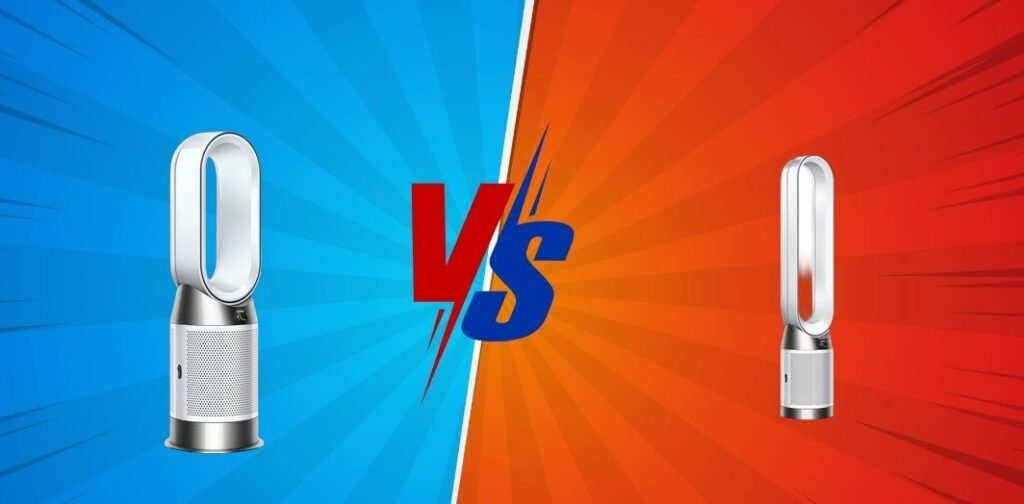
While the HP10 and TP10 perform the same job when it comes to cleaning air, their physical designs are quite different—especially in height, footprint, and overall presence in a room. These differences can make one a better fit depending on your space and aesthetic preferences.
TP10: Tall, Slim Tower for Tight Spaces
The TP10 is a vertical tower purifier, standing at 41.3 inches (105 cm)—over a foot taller than the HP10. Despite its height, it’s surprisingly narrow:
– Width: 8.7 inches
– Depth: 4.72 inches
– Weight: 10.4 lbs
Its slim, bladeless tower design makes it ideal for tight corners, beside furniture, or in apartments where floor space is limited. The 9.7-inch base diameter provides stability, but the unit’s tall profile means it’s best placed where it won’t be easily bumped.
Because it’s discontinued, you won’t find it on Dyson’s main site as new stock, but certified refurbished units are still available and often in excellent condition. Many users appreciate how the TP10 blends into modern decor with its minimalist vertical silhouette.
HP10: Compact, Squat Tower with Heating Base
In contrast, the HP10 is shorter but wider, designed to house its ceramic heating element:
– Height: 30.2 inches (77 cm)
– Footprint: 9.84″ × 9.84″ — a more square, compact base
– Weight: 11.66 lbs — heavier due to internal heating components
– Base Diameter: 8.6 inches
The HP10 looks more like a hybrid heater-fan, with a broader, sturdier base. Its lower center of gravity makes it more stable, especially in homes with kids or pets. While it takes up more floor space front-to-back, it’s less likely to feel “towering” in a room.
Because the HP10 is still in production, it’s easier to find as new stock and comes with full manufacturer support, which adds to its long-term appeal.
Which One Blends In Better?
- Modern minimalist spaces: The TP10 wins with its sleek, vertical profile that looks like a high-end design object.
- Bedrooms or living rooms with floor space: The HP10’s shorter height may feel less intrusive.
- Safety with kids or pets: The HP10’s lower, wider stance is more stable and less likely to tip.
Good to Know: If you’re placing the unit in a tight hallway, beside a nightstand, or behind a couch, the TP10’s slim depth gives it a clear advantage. But if you’re worried about stability or prefer a more compact footprint, the HP10 is the safer choice.
View [Dyson HP10] on Amazon [link]
View [Dyson TP10] on Amazon [link]
Heating vs Cooling: What Can Each Actually Do?
This is where the HP10 and TP10 diverge completely—and it’s the single biggest factor that should influence your decision.
HP10: Real Heater, Not Just a Fan
The HP10 is a 3-in-1 device: it purifies, cools, and heats. That heating function is a game-changer for many users:
– Ceramic heating element: Provides real, measurable warmth—tested to heat rooms up to 872 sq ft (per Dyson’s DTM961 test method).
– Auto temperature control: Set your desired temp (between 37°F and 95°F), and the HP10 will maintain it, adjusting fan speed and oscillation as needed.
– Whole-room heating: Unlike small space heaters that only warm a corner, the HP10 uses 350° oscillation to distribute heat evenly.
This makes the HP10 a legitimate alternative to a space heater, especially in bedrooms, home offices, or drafty apartments. If you live in a region with cold winters, the HP10 can reduce reliance on central heating, saving energy and money.
TP10: Fan-Based Cooling Only
The TP10, as the name suggests, is a purifying fan—it does not heat. Its cooling effect comes entirely from airflow:
– Air Multiplier™ technology: Creates a smooth, powerful stream of air for personal cooling.
– Jet Focus mode: Concentrates airflow in one direction for targeted cooling (e.g., at your desk or bed).
– Night Mode: Ultra-quiet operation with a dimmed display, ideal for sleeping.
It’s great for summer or mild climates, but useless in winter. You’ll still need a separate heater, which adds to both cost and clutter.
So, Which Climate Are You In?
- Four-season homes with cold winters: The HP10 is the obvious choice. It’s a year-round solution.
- Mild or warm climates (e.g., California, Florida, Arizona): The TP10 is sufficient and avoids paying for a heating feature you’ll never use.
- Renters without central heat: The HP10 could be a lifesaver during cold months.
🏆 Section Winner: HP10
The HP10’s heating capability gives it massive functional advantage in cold climates. The TP10 is limited to fan-based cooling only.
See current deals on [Dyson HP10] here [link]
Check the latest price of [Dyson TP10] on Amazon [link]
Are Controls and Daily Use the Same?
When it comes to daily operation, the HP10 and TP10 are nearly identical—which is a good thing. Both are intuitive, user-friendly, and designed for hands-off use.
Identical Remote, Same User Experience
Both models come with a magnetic curved remote that stores neatly on top of the unit. It includes:
– 10-speed fan control
– Oscillation on/off
– Night Mode
– Timer (1–9 hours)
– Power button
– Mode selection (Auto, Jet Focus, etc.)
The LCD screen on both units shows the same information: real-time air quality (PM1, PM2.5, PM10, VOCs, NO₂), current mode, temperature, and filter life. The display is bright and easy to read, even from across the room.
Night Mode Is a Shared Strength
Both units feature Night Mode, which:
– Reduces fan noise to near-silent levels
– Dims the display to avoid light pollution
– Maintains Auto Mode for continuous air cleaning
Users report excellent sleep quality with either model in Night Mode, especially on lower fan speeds.
Filter Life Indicator Works the Same
Both have an on-screen filter life indicator that tracks usage and alerts you when it’s time to replace the filter—typically after 12 months under normal conditions. The replacement process is tool-free and takes less than a minute.
Note: Both require the same $89–$95 Dyson-branded filter. There are no officially supported third-party filters, so ongoing costs are locked in.
🏆 Section Winner: Tie
Controls, remote, display, and daily usability are identical between the HP10 and TP10.
View [Dyson HP10] on Amazon [link]
View [Dyson TP10] on Amazon [link]
What’s in the Box—and What You’ll Pay Extra For?
Both Include:
- Unit with pre-installed filter
- Magnetic remote (AAA batteries included)
- Quick-start guide and power cord (5.9 ft)
Accessories You Might Want to Buy:
- Extra filters: ~$89–$95 (Dyson branded, same for both)
- Filter subscription: Available through Dyson for automatic delivery
- Dust cover: Not included—recommended for off-season storage
- Replacement remote: Available if lost (~$30)
Pro Tip: Since both models lack Wi-Fi, there’s no app to control them. If smart home integration is important, consider newer Dyson models like the HP07 or PC1.
Check the latest price of [Dyson HP10] on Amazon [link]
See current deals on [Dyson TP10] here [link]
How Do They Feel to Live With Every Day?
TP10: Great for Airflow, But Watch Out for the “Cicada Noise”
The TP10 excels in cooling and air circulation, especially in summer. Users love its Jet Focus mode for personal cooling and its quiet Night Mode. However, a widespread issue plagues many TP10 units: the “cicada noise”.
This is a high-pitched whine—like a buzzing insect—that develops after a few hours of operation. It’s often linked to motor or impeller wear and is more common in older or refurbished units. While certified refurbished models come with a 2-year warranty, some users report inconsistent customer service when trying to get repairs or replacements.
HP10: Heavier, Slightly Noisier, But More Versatile
The HP10 has a slight hum during heating cycles, but it’s generally not disruptive. Its Auto Mode seamlessly adjusts fan and heat output, making it low-maintenance.
Because it’s still in production, parts, support, and repairs are more reliable. The additional moving parts (heater, thermostat) mean slightly higher long-term wear risk, but overall reliability is better than the discontinued TP10.
Real-World Daily Use Scenarios:
| Scenario | HP10 | TP10 |
|---|---|---|
| Allergy season | ✅ Excellent filtration | ✅ Same performance |
| Winter heating | ✅ Heats entire room | ❌ No heating |
| Summer cooling | ✅ Fan-only mode | ✅ Jet Focus cooling |
| Bedroom at night | ✅ Quiet Night Mode | ✅ Same, but risk of whine |
| Pet owner | ✅ Removes dander/odors | ✅ Same |
| Apartment dweller | ⚠️ Larger footprint | ✅ Slimmer, fits tight spaces |
🏆 Section Winner: HP10
The HP10’s ongoing support and lack of widespread noise issues make it the more reliable daily companion.
View [Dyson HP10] on Amazon [link]
View [Dyson TP10] on Amazon [link]
How Much Maintenance Do They Really Need?
Identical Filter Replacement Process
Both models require a new filter every 12 months, though heavy pollution or pet ownership may shorten this. The quick-release mechanism makes replacement easy—no tools needed.
But here’s a hidden advantage for the HP10: it includes a permanent catalytic filter that breaks down formaldehyde and other VOCs without needing replacement. The TP10 lacks this feature.
Cleaning & Care Are Simple
- Wipe exterior with a dry cloth
- Dust intake grilles monthly
- No washable components
Long-Term Ownership Cost (5-Year Estimate):
| Cost Factor | HP10 | TP10 |
|---|---|---|
| Unit (refurbished) | $350 | $250 |
| Filters (5 × $90) | $450 | $450 |
| Repairs (potential) | Lower risk | Higher risk (motor noise) |
| Total | $800 | $700 |
While the TP10 is cheaper upfront, the HP10 offers better long-term value if you use heating and appreciate the catalytic filter.
🏆 Section Winner: HP10
The catalytic filter and lower repair risk give the HP10 a clear long-term advantage.
Check the latest price of [Dyson HP10] on Amazon [link]
See current deals on [Dyson TP10] here [link]
Full Specs Side-by-Side
| Feature | Dyson HP10 | Dyson TP10 |
|---|---|---|
| Model Type | Purifier Hot+Cool | Purifier Cool |
| Release Status | Still in production | Discontinued (refurbished only) |
| Dimensions (H×W×D) | 30.2″ × 9.84″ × 9.84″ | 41.3″ × 8.7″ × 4.72″ |
| Weight | 11.66 lbs | 10.4 lbs |
| Airflow | 291 L/s | 290 L/s |
| Room Coverage | Up to 872 sq ft | Up to 872 sq ft |
| Filtration | HEPA H13 + Carbon + Catalytic | HEPA H13 + Carbon |
| Sealed System | Yes | Yes |
| Heating Function | Yes (ceramic element) | No |
| Cooling | Fan-based only | Fan-based with Jet Focus |
| Oscillation | 350° | 350° |
| Auto Mode | Yes | Yes |
| Night Mode | Yes | Yes |
| LCD Display | Yes (air quality, filter life) | Yes (same) |
| Remote Control | Magnetic, 10-speed | Magnetic, 10-speed |
| App/Wi-Fi | No | No |
| Filter Life | 12 months | 12 months |
| Filter Price | ~$90 | ~$90 |
| Warranty (refurbished) | 2 years | 2 years |
| Known Issues | Minor heating hum | “Cicada” noise, motor whine |
| Best For | All-season use, heating needed | Warm climates, space-saving |
So, Which One Should You Actually Buy?
The HP10 Wins for Most People—If You Can Afford It
It’s more versatile, future-proof, and reliable. The ability to heat, cool, and purify in one unit justifies the higher price—especially if you live in a climate with cold winters. The catalytic filter is a silent upgrade that extends its VOC-fighting power beyond the TP10.
Buy the HP10 if you:
– Need supplemental heating
– Want a single unit for year-round use
– Prioritize long-term reliability
– Don’t mind a slightly bulkier design
The TP10 Is a Bargain—But Only If You’re Okay With the Risks
At $250 refurbished, it’s a steal for purification and cooling only. But the discontinuation, cicada noise reports, and lack of heating make it a gamble.
Buy the TP10 if you:
– Live in a warm climate
– Need a slim, tall purifier for tight spaces
– Are on a tight budget and accept potential noise issues
– Plan to use it only in summer or mild seasons
View [Dyson HP10] on Amazon [link]
View [Dyson TP10] on Amazon [link]
Final Verdict: HP10 Is the Smarter Long-Term Choice
While the TP10 offers great value on paper, the HP10 delivers more real-world utility and durability. For just $100–$150 more (even when buying refurbished), you get heating, a catalytic filter, and ongoing manufacturer support. The TP10’s noise issues and discontinuation make it a risky pick unless you’re in a warm climate and need a space-saving purifier.
Who Should Buy Which?
- Best for cold climates: Dyson HP10 — no contest
- Best budget pick (with caveats): Dyson TP10 (refurbished) — only if you skip winter use
- Best for allergy sufferers: HP10 — superior VOC breakdown
- Best for small apartments: TP10 — slimmer footprint
- Best long-term investment: HP10 — still supported, more features
If you’re buying used or refurbished, spend the extra for the HP10. It’s not just a purifier—it’s a year-round air solution. The TP10 is a relic of its time: capable, but outshined by its sibling that does more, lasts longer, and heats your home when it matters most.