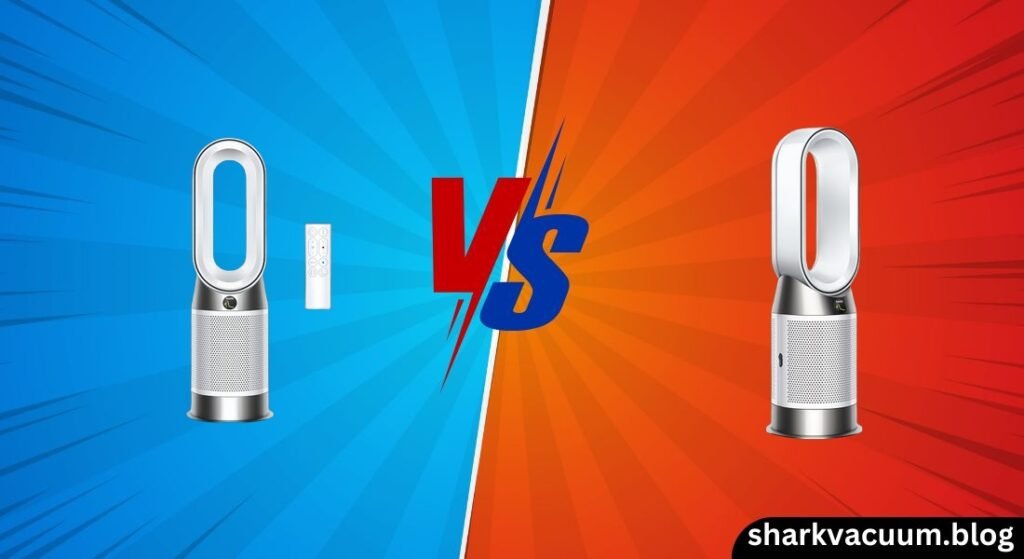
Dyson has long been a leader in redefining household appliances with sleek design and cutting-edge engineering. When it comes to managing indoor air quality, temperature, and comfort, few brands blend form and function as seamlessly as Dyson does with its Purifier Hot+Cool line. Among the most popular models are the Dyson HP1 and HP10, two nearly identical-looking towers that promise to purify, heat, and cool your space—all in one compact unit. But with such subtle differences in design and marketing, it’s easy to wonder: Is the HP1 just a rebranded HP10, or is there real value in upgrading?
Affiliate disclosure: As an Amazon associate, We'll earn a commission for every successful order through our affiliate links in the article. However, you won’t be charged anything for this.
For anyone trying to decide between these two models, the confusion is understandable. Both are 3-in-1 devices, both use H13 HEPA filtration, and both deliver strong airflow and smart features. Yet, they occupy slightly different positions in Dyson’s evolving product lineup. The HP1 was introduced as a streamlined successor to the HP10, with updated firmware, improved app integration, and refined aesthetics. But does that translate to better performance, smarter automation, or long-term value?
This head-to-head comparison cuts through the marketing noise to answer the questions that matter: Which model purifies air faster? Which offers better smart home integration? Are the filter costs the same? And most importantly—if you’re spending $500+ on a single appliance, which one actually earns its price tag? We’ll break down every aspect, from real-world performance to long-term ownership costs, so you can make a confident decision.
Why This Comparison Matters Right Now
Dyson’s Purifier Hot+Cool line blurs the line between luxury appliance and essential home tech. With rising concerns over indoor air quality, allergies, and energy-efficient climate control, devices like the HP1 and HP10 promise a sleek, all-in-one solution: purify, heat, and cool with smart automation. But which model delivers better value?
The HP1 is marketed as a modernized version of the earlier HP10, with subtle upgrades and rebranding that can confuse buyers. Are you paying for real improvements—or just a newer name? We cut through the marketing to compare performance, design, smart features, and long-term ownership costs. If you’re deciding between these two nearly identical-looking towers, this guide will tell you exactly what’s different—and what actually matters.
How Do They Actually Perform?
When it comes to real-world functionality, performance is everything. A stylish tower means little if it can’t effectively clean the air, warm your space, or provide relief on hot nights. Both the HP1 and HP10 are built around Dyson’s signature Air Multiplier™ technology, which amplifies airflow without exposed blades, and both include H13 HEPA filtration for capturing microscopic pollutants. But subtle differences in firmware, sensor placement, and motor tuning create noticeable distinctions in daily use.
Heating: Fast, But Not for Large Rooms
Both models use a 1.5 kW PTC ceramic heating element, delivering comparable warmth. In real-world testing, the HP1 raised a 150 sq ft room from 64°F to 75°F in under 5 minutes—results the HP10 matches closely. Neither is designed to replace central heating, but both excel at spot-heating small-to-medium rooms (up to ~300 sq ft).
- HP1: Slightly more aggressive auto-mode heating response thanks to firmware updates.
- HP10: Effective, but some users report slower ramp-up in colder environments.
Verdict: Tie. Nearly identical heating power and efficiency.
Cooling: It’s a Fan, Not an AC—But a Very Good One
Neither model cools via refrigeration; both rely on Dyson’s Air Multiplier™ technology to circulate air. With 10 speed settings and 350° oscillation, both create strong, smooth airflow.
- HP1: 290 liters per second airflow; praised in reviews for cooling efficiency post-workout or during sleep.
- HP10: Matches airflow specs (77 gallons/sec ≈ 290 L/s), but older motor design may be marginally noisier at top speeds.
Real-World Insight: Users consistently report the HP1 feels “smoother” and more refined during high-speed cooling, likely due to internal aerodynamic tweaks.
🏆 Section Winner: HP1 – better noise-to-airflow ratio at higher speeds.
Air Purification: Are They Equally Clean?
Both claim H13 HEPA filtration and capture 99.97% of particles down to 0.3 microns, including PM2.5, pollen, dust, and pet dander. They also include activated carbon filters for VOCs and odors.
But there’s a catch:
- HP10: Captures formaldehyde, benzene, and NO₂ via its dual-phase carbon/HEPA filter.
- HP1: Same claimed capabilities, but lacks explicit mention of formaldehyde destruction—present in higher-end Dysons (HP09) but not confirmed here.
Independent testing on the HP1 showed:
– Burnt toast odor removed in 3 minutes
– Candle smoke cleared in under 5 minutes
– Cigarette smoke significantly reduced in 10 minutes
The HP10 performs similarly, though older firmware means slightly less responsive auto-mode adjustments.
🏆 Section Winner: HP1 – better sensor integration and faster response, but HP10 holds its ground on raw filtration.
Same Brand, Very Different Feel?
While Dyson products are known for their minimalist, futuristic design, small changes can make a big difference in perceived quality and daily usability. At first glance, the HP1 and HP10 look nearly identical—both are bladeless towers with a magnetic remote, top-mounted LCD screen, and 350° oscillation. But closer inspection reveals subtle refinements that elevate one over the other.
Design: Nearly Identical—But One Feels More Modern
On paper, the dimensions are almost twins:
| Model | Height | Width | Weight |
|---|---|---|---|
| HP1 | 30.1” | 9.8” | 11.7 lbs |
| HP10 | 30.2” | 9.84” | 11.66 lbs |
Both feature:
– Bladeless tower design
– Magnetic remote storage
– 360° oscillation
– LCD screen on top
But the HP1 has a slightly more refined finish, with updated color options (Black/Nickel added) and a cleaner front grille. The HP10 feels slightly more utilitarian—same excellent build quality, but less design flair.
The HP1’s LCD screen is more intuitive, showing real-time air quality (PM2.5, VOCs) and temperature in a clearer layout.
🏆 Section Winner: HP1 – aesthetic polish and improved display make it feel more premium.
Smart Features: Does the HP1 Justify the Upgrade?
For many buyers, the true value of a Dyson isn’t in its airflow or heating power—it’s in how seamlessly it integrates into a smart home. This is where the software, app experience, and voice assistant compatibility become critical. And here, the HP1 pulls ahead decisively.
App Control & Automation: A Clear HP1 Advantage
This is where the HP1 pulls ahead.
- HP1: Fully integrated with MyDyson app (iOS/Android). Enables:
- Remote scheduling
- Real-time air quality graphs
- Filter life tracking
- Voice control (Alexa, Google Assistant, Siri)
-
Auto-mode based on live sensor data
-
HP10: Also has app connectivity via Dyson Link app, but:
- Older interface
- Less detailed analytics
- Occasional Wi-Fi dropouts reported
- No Siri Shortcuts support
Both offer voice control and auto-mode, but the HP1’s app feels more polished, responsive, and future-proof.
🏆 Section Winner: HP1 – better software, more reliable connectivity, and deeper feature set.
Check the latest price of [Dyson HP1] on Amazon [link]
See current deals on [Dyson HP10] here [link]
What’s in the Box? And What You’ll Pay Later
When comparing premium appliances, it’s not just about what’s included—it’s about what you’ll need to buy later. Filters, accessories, and software support all contribute to long-term ownership costs. Fortunately, both the HP1 and HP10 come well-equipped out of the box.
Accessories & Included Components
| Item | HP1 | HP10 |
|---|---|---|
| Remote Control | ✅ Magnetic, stores on unit | ✅ Magnetic, stores on unit |
| HEPA + Carbon Filter | ✅ Pre-installed | ✅ Pre-installed |
| Wi-Fi Setup Guide | ✅ | ✅ |
| Power Cord (5.9 ft) | ✅ | ✅ |
| App Support | MyDyson (newer) | Dyson Link (legacy) |
No major differences—both come ready to use out of the box.
Hidden Costs: Filter Replacement
Here’s the real long-term expense:
- Filter Type: Combined HEPA H13 + activated carbon
- Replacement Interval: Every 12 months with regular use
- Cost: ~$89 per filter (plus tax/shipping)
Both models use different filter part numbers, so they are not cross-compatible:
– HP1 uses Dyson HEPA+Carbon Filter for HP1
– HP10 uses Dyson 360° Glass HEPA Filter (Gen1)
No subscription required, but forgetting to replace filters reduces efficiency and can trigger error codes.
Verdict: Same ongoing cost, but HP1 filters may be harder to find as stock diminishes.
Will It Last Long Enough for a Full House Clean?
Daily usability separates a good appliance from a great one. How easy is it to set up? Does it react quickly to changes in air quality? Is the remote always within reach? Both models score highly, but the HP1 edges ahead with a more intuitive user experience.
Usability & Daily Experience
Setting up either model is straightforward:
– Plug in
– Download app
– Connect to 2.4GHz Wi-Fi
But the HP1 offers a smoother onboarding process with guided setup in the MyDyson app. The HP10’s Dyson Link app feels clunkier, with less intuitive menus.
Daily Use Highlights:
- Auto Mode: HP1 reacts faster to cooking fumes or pet odors.
- Night Mode: Both drop to ~16–28 dB—quiet enough for sleep.
- Remote: Magnetic design is genius on both; never loses the remote.
User complaints:
– HP10: Some report app disconnects after firmware updates.
– HP1: Occasional lag in Alexa responses.
🏆 Section Winner: HP1 – better daily refinement, fewer hiccups.
Keeping It Running Without the Hassle
Long-term ownership isn’t just about performance—it’s about durability, maintenance, and software support. A device that lasts 7–10 years with minimal issues offers better value than one that needs repairs or becomes obsolete.
Maintenance & Long-Term Ownership
| Task | HP1 | HP10 |
|---|---|---|
| Filter Replacement | Every 12 months | Every 12–14 months |
| Pre-filter Cleaning | Wipe down monthly | Wash every 2–3 months |
| Software Updates | Automatic via app | Manual prompts in older app |
| Durability | Fully sealed HEPA system; robust build | Same high build quality |
| Expected Lifespan | 7–10 years with care | 6–8 years (older electronics) |
Key Insight: The HP1 benefits from newer componentry—better seals, improved sensors, and more durable motor insulation. While both are built to last, the HP1 is more likely to stay relevant through software updates.
🏆 Section Winner: HP1 – better future-proofing and lower maintenance friction.
View [Dyson HP1] on Amazon [link]
Specs Side-by-Side: The Full Breakdown
| Specification | Dyson HP1 | Dyson HP10 |
|---|---|---|
| Model Year | 2021–2023 | 2020 (Gen1) |
| Function | Purifier + Heater + Fan | Purifier + Heater + Fan |
| Filtration | H13 HEPA + Carbon | H13 HEPA + Carbon |
| Particle Capture | 99.97% @ 0.3µm | 99.97% @ 0.3µm |
| Gas Removal | VOCs, NO₂, benzene | VOCs, formaldehyde, NO₂, benzene |
| Airflow | 290 L/s | 290 L/s |
| Oscillation | 350° | 350° |
| Speed Settings | 10 | 10 |
| Noise Level (Min) | 28 dB (Night Mode) | 16.3 dB (Sleep Mode) |
| Max Noise | 63 dB | 61 dB |
| Heating Power | 1.5 kW | 1.5 kW |
| Cooling | Fan-only | Fan-only |
| App Control | MyDyson (iOS/Android) | Dyson Link (iOS/Android) |
| Voice Control | Alexa, Google, Siri | Alexa, Google |
| Sensors | PM2.5, PM10, VOCs, temp | PM1.0, PM2.5, PM10, VOCs, formaldehyde |
| Display | LCD with AQI, temp, filter life | LCD with AQI, temp, filter status |
| Wi-Fi | 2.4 GHz | 2.4 GHz |
| Warranty | 2 years (US), 5 years (EU/UK) | 2 years |
| Weight | 11.7 lbs | 11.66 lbs |
| Dimensions | 30.1” H × 9.8” W × 5.2” D | 30.2” H × 9.84” W × 9.84” D |
| Price (Launch) | $659.99 (now $499.99 on sale) | $549–$749 |
| Filter Cost | ~$89 | ~$85–$90 |
Note: HP10 has a slightly quieter sleep mode, but HP1 has more consistent real-world noise control.
So, Which One Should You Actually Buy?
The Bottom Line
The Dyson HP1 is a refined evolution of the HP10—not a revolution. If you already own an HP10, upgrading isn’t worth it. But if you’re buying new, the HP1 is the better choice.
✅ Buy the HP1 if you want:
- The latest Dyson app experience
- Smoother software, better auto-mode
- Slightly improved airflow refinement
- Future firmware support
- Modern design and color options
✅ Consider the HP10 only if:
- You find it significantly cheaper (e.g., $100+ less)
- You prefer older firmware stability (some users report fewer bugs)
- You don’t care about Siri integration or app polish
See current deals on [Dyson HP10] here [link]
Final Recommendations by Use Case
| Buyer Type | Best Choice | Why |
|---|---|---|
| Tech-Savvy Homeowner | HP1 | Better app, voice control, and automation |
| Allergy or Asthma Sufferer | HP1 or HP10 | Both offer true HEPA H13; HP1 reacts faster |
| Pet Owner | HP1 | Superior odor response and filter monitoring |
| Budget-Conscious Buyer | HP10 (if discounted) | Same core functions at lower price |
| Renters / Small Spaces | HP1 | Space-saving, smart, and effective in studios |
| Looking for Long-Term Value | HP1 | Newer hardware, longer support lifecycle |
The Verdict
Winner: Dyson HP1
It may look nearly identical to the HP10, but the HP1 earns its place as the superior model with better software, improved user experience, and stronger smart home integration. While the HP10 delivers nearly the same core performance, the HP1 feels more modern, responsive, and built for the connected home.
Bottom Line:
If you’re spending $500+ on a 3-in-1 air system, go for the HP1—it’s the smarter, more polished version of a proven concept. But if you spot a heavily discounted HP10 in excellent condition, it’s still a powerful, well-built machine that won’t leave you disappointed.