
Affiliate disclosure: As an Amazon associate, We'll earn a commission for every successful order through our affiliate links in the article. However, you won’t be charged anything for this.
That sleek ring on your Dyson air purifier looks like a natural handle—but grabbing it could destroy your $500 machine in seconds. Thousands of users accidentally crack internal components by lifting the wrong way, turning a simple room-to-room move into an expensive repair. Dyson explicitly forbids carrying by the loop amplifier in their manuals, yet this remains the #1 cause of preventable damage during transport. Whether you’re shifting it across your living room or flying internationally, this guide reveals exactly how to move your purifier safely using Dyson’s engineering specs and real-world shipping protocols. You’ll learn the one grip point that won’t snap plastic housings, the double-boxing method airlines require, and critical voltage checks that prevent fried circuitry overseas.
Why Lifting by the Loop Amplifier Destroys Your Dyson

Dyson’s loop amplifier—the circular top ring that circulates air—is engineered for airflow, not weight-bearing. When users lift by this section, they apply torque to fragile internal mounts connecting the ring to the base. This causes hairline fractures in the plastic couplings that often go unnoticed until airflow drops 30% or error lights flash. The owner’s manual states unequivocally: Never carry the machine by the loop amplifier. These cracks worsen with vibration during transport, eventually causing the ring to wobble or detach mid-operation. Even a 10-second lift by the ring risks misaligning the Air Multiplier™ technology, forcing you to replace the entire upper assembly at $200+.
How to Identify Safe Lifting Points Immediately
- The Base Is Your Only Safe Grip: Locate the widest, heaviest section where the machine meets the floor. On HP09 models, this is the 8-inch diameter shroud housing the HEPA filter; on newer Purifier Cool models, it’s the weighted circular platform. This area contains reinforced mounting points designed to handle the full 15-22 lb weight.
- Critical Visual Cue: Run your fingers along the base seam. If you feel a slight ridge or texture difference (common on TP07+ models), that’s the engineered stress point—grip here.
- Red Flag Warning: If you see any gap between the loop amplifier and base before moving it, do not lift. Existing separation indicates prior damage that will worsen during transport.
How to Move Your Purifier Within Your Home Safely
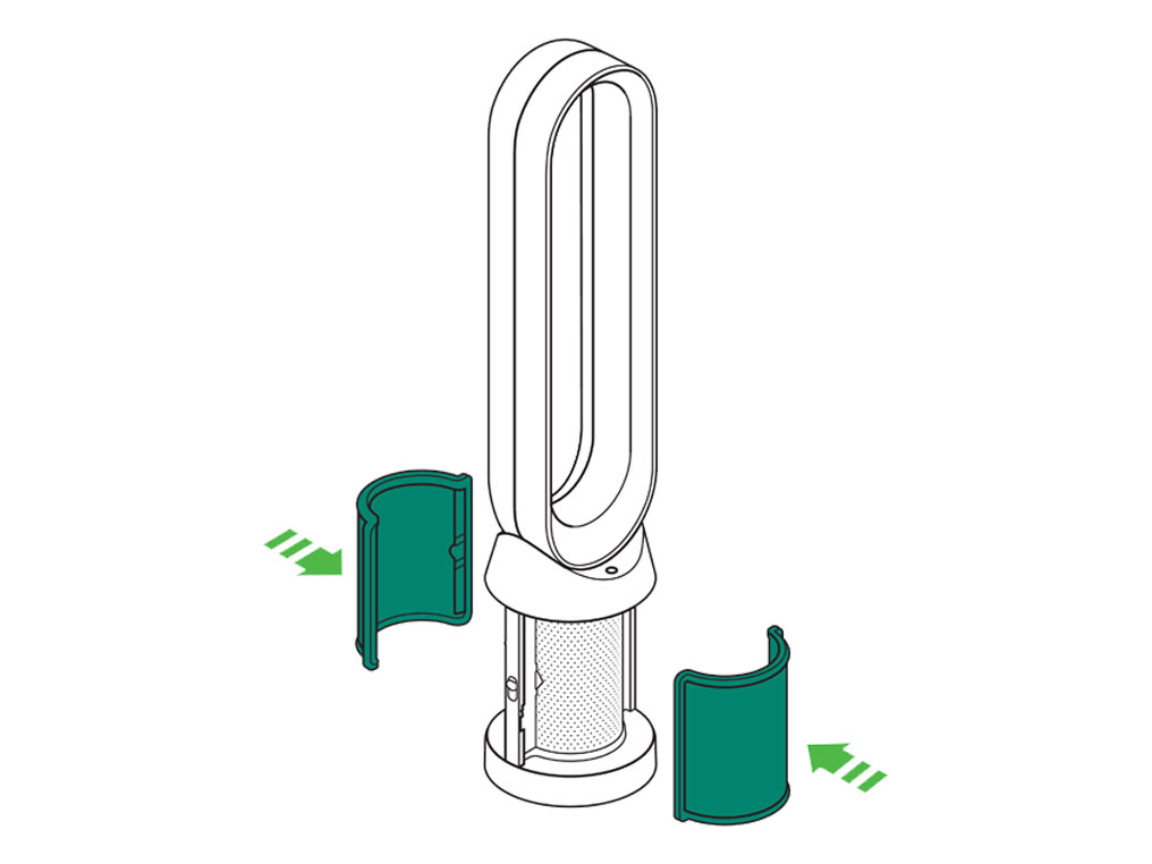
Moving between rooms seems simple but causes 40% of Dyson transport damage when done incorrectly. The key is maintaining strict vertical alignment and eliminating strain on the neck joint.
Correct Room-to-Room Carrying Technique
- Power Down & Cool: Unplug and wait 20 minutes if recently used—the motor housing can exceed 140°F.
- Two-Hand Base Grip: Place one hand flat under the front edge of the base, the other supporting the back. Keep elbows tucked to your ribs.
- Upright Transport Only: Hold the unit perfectly vertical (max 5° tilt). Tilting beyond 45° displaces carbon filters, creating dust clouds inside the housing.
- Clear Your Path: Remove rugs or cords first—stumbling while gripping only the base risks dropping the entire unit.
When to Use a Rolling Platform Instead
For frequent moves or models over 18 lbs (like the Purifier Humidify+Cool), ditch manual carrying. A $15 plant caddy with locking casters solves this:
– Measure your base diameter (most are 7-9 inches)
– Choose a caddy with non-slip rubber matting
– Secure the purifier with Velcro straps through the base vents
– Pro Tip: Add tennis balls to caddy corners to prevent floor scratches during pivots
How to Double-Box Your Dyson for Air Travel or Shipping
Shipping a Dyson without double-boxing invites disaster. One user reported arriving to find their unit crushed because the carrier stacked boxes 8 high—original packaging alone can’t withstand 200+ lbs of pressure. The “box-in-a-box” method is non-negotiable for air travel or cross-country moves.
Step-by-Step Double-Boxing Protocol
- Drain & Dry: For humidifying models (HP07, PH04), remove the tank and run a dry cycle for 1 hour to evaporate residue. Water leaks void warranties.
- Wrap the Unit: Cover the entire purifier in 3 layers of 1/4″ bubble wrap, paying special attention to the mesh intake vents on the base—these bend easily.
- First Box: Place in original box with foam inserts. No originals? Line a new box with 2″ foam sheets, filling voids with crumpled kraft paper.
- Second Box: Choose a box 4″ larger on all sides. Fill bottom with 3″ of packing peanuts, then nest the first box. Surround with 4″ of peanuts on sides/top.
- Critical Labeling: Mark “FRAGILE: ELECTRONIC AIR PURIFIER” and “THIS SIDE UP” in 2-inch letters. Add a handwritten note: “Do NOT X-Ray—Contains Lithium Battery” if applicable.
Airline-Specific Packing Rules You Must Know
- Carry-On Limits: TSA requires purifiers to fit under the seat (max 18x14x8″). HP09 models exceed this—check as luggage.
- Lithium Battery Restrictions: Models with battery backup (like TP09) must have batteries ≤100Wh. Most Dysons fall under 50Wh, but always remove batteries for checked luggage.
- Security Screening: Expect to power on the unit at checkpoints. Pack the cord in an easily accessible pouch.
Avoiding International Voltage Disasters

Taking your Dyson to Europe or Asia without checking voltage fries circuit boards instantly. A traveler in Tokyo plugged their US-spec HP04 into a 100V outlet (Japan’s standard) only to smell burning electronics—their model required 120V. Dyson uses region-locked power supplies; no plug adapter can fix this.
The 3-Step International Travel Checklist
- Check the Rating Label: Flip your unit. If it says “100-120V” (North America/Japan), it won’t work in 220-240V countries (Europe/Asia) without a transformer.
- Transformer Requirements: For 220V → 120V conversion, use a 1500W+ transformer (Dyson draws 55W but needs surge capacity). Cheap adapters overheat—spend $80+ on a Furman unit.
- Plug Compatibility: Even with correct voltage, you’ll need a Type G adapter (UK) or Type I (Australia). Never force plugs—the socket may melt.
Post-Transport Damage Prevention Protocol
Plugging in immediately after moving risks short circuits from temperature shock or displaced filters. Follow this 4-step verification before powering on:
- Visual Inspection: Check for hairline cracks where the loop meets the base (common failure point). Shine a flashlight at a 45° angle to spot micro-fractures.
- Rattle Test: Gently shake the unit near your ear. Any loose parts indicate broken mounts—do not operate.
- Temperature Acclimation: If moved from cold (<40°F) to warm air, wait 90 minutes. Condensation inside electronics causes corrosion.
- Filter Reset: After transport, run the purifier on max speed for 10 minutes with windows open. This clears carbon dust dislodged during movement.
Why Daily Movement Requires Different Tactics
Frequent movers (like office cleaners shifting purifiers between meeting rooms) face unique risks. One facilities manager reported 3 units failing within months because staff carried them by the power cord—a habit that severs internal wiring at the strain relief point.
Safe Daily Transport System
- Base-Only Carrying: Enforce a “two hands on base” rule. Post a 3″x5″ card on each unit: “GRIP HERE →” with arrows pointing to the base seam.
- Rolling Caddy Hack: Mount a $12 IKEA RÅSKOG cart with non-marking wheels. Slide the purifier onto the bottom shelf—no lifting required.
- Emergency Stop: If tripping, drop the unit vertically. Letting it fall sideways shatters the loop amplifier; dropping straight down uses the base’s shock absorption.
Moving your Dyson air purifier correctly isn’t just about convenience—it’s protecting a precision-engineered system where a single cracked mount can degrade air cleaning by 40%. Always grip the base, never exceed 45° tilt, and double-box for any journey beyond your living room. For international trips, verify voltage compatibility before packing—no transformer can salvage a melted circuit board. Implement the rolling caddy system if moving daily, and never skip the post-transport checklist. These steps take 2 extra minutes but prevent $300+ repairs. When in doubt, consult Dyson’s shipping guidelines—your model’s serial number unlocks specific transport protocols on their support portal. Keep your purifier performing like new by treating its transport with the same precision Dyson used in its design.
![How To Change Dyson Airwrap Filter [Full Guide]](https://dfixing.com/wp-content/uploads/2026/03/Dyson-Airwrap-2-1024x576.png)