
Affiliate disclosure: As an Amazon associate, We'll earn a commission for every successful order through our affiliate links in the article. However, you won’t be charged anything for this.
You’re staring at that smooth, bladeless loop on your Dyson fan, wondering how it moves air without spinning blades. Unlike traditional fans that chop the air with visible blades, your Dyson creates a powerful, uninterrupted breeze that feels mysteriously smooth. This isn’t magic—it’s precision engineering leveraging fluid dynamics principles most fans ignore. If you’ve ever questioned how do Dyson air multiplier fans work or wondered why they’re quieter and safer than conventional models, you’re about to discover the hidden mechanics that turn a small jet of air into a room-filling breeze. You’ll learn exactly how the Coandă effect amplifies airflow, why the “bladeless” design is actually smarter engineering, and what makes these fans worth their premium price.
Why Your Dyson Fan Has No Visible Blades But Still Moves Serious Air
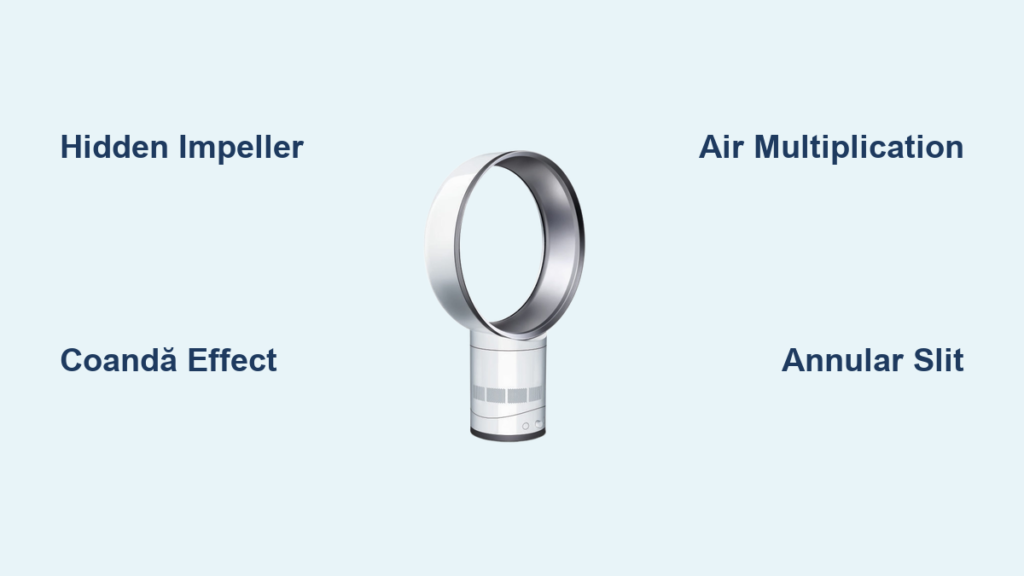
The “bladeless” label is technically misleading—Dyson fans absolutely contain blades, but they’re cleverly hidden in the base. This strategic concealment solves two critical problems traditional fans can’t: safety hazards from exposed blades and turbulent, noisy airflow. Inside the pedestal, a brushless DC motor spins a mixed-flow impeller with backward-curved blades optimized for maximum efficiency. Unlike axial fans that pull air straight through, this centrifugal impeller draws air through a 360-degree intake grill at the base, compressing it before forcing it upward. The real innovation begins when this pressurized air enters the hollow ring—and that’s where the air multiplication magic starts.
How the Hidden Impeller Creates the Initial Air Jet
The impeller isn’t your grandfather’s fan blade. Its backward-curved, aerodynamically sculpted blades function like a miniature jet engine compressor, moving air at high pressure with minimal turbulence. As the brushless DC motor spins at high RPMs (typically 1,025 to 3,300 depending on model), it draws room air from all directions through the base’s intake vents. This omnidirectional intake allows the fan to pull from a larger air volume than rear-facing traditional fans. The impeller compresses this air, increasing its velocity before channeling it through the hollow stalk into the ring. Crucially, this initial airflow is not the breeze you feel—it’s merely the “seed” that triggers the amplification process.
Diagnosing Weak Airflow: 3 Impeller Checks You Must Perform
If your Dyson’s airflow feels weaker than usual, the impeller is often the culprit. First, unplug the unit and remove the base cover (usually requiring a Torx T15 screwdriver). Check for dust bunnies clogging the 360-degree intake grill—this restricts initial airflow. Next, inspect the impeller blades for hair or debris wrapped around the shaft; a cotton swab works perfectly for removal. Finally, listen for unusual grinding sounds when powering on: a failing brushless motor often emits high-pitched whines before complete failure. Pro Tip: Clean the impeller monthly in dusty environments—just 2 minutes prevents 80% of weak airflow complaints.
How the Coandă Effect Turns a Tiny Jet Into a Powerful Breeze

That smooth ring isn’t just for looks—it’s an engineered airfoil surface critical to the fan’s operation. When the impeller’s high-pressure air exits through the ring’s narrow annular slit (just 1.3mm wide in most models), it forms a thin, high-velocity “air blade.” This is where physics takes over: the Coandă effect causes this fast-moving airstream to cling to the ring’s curved inner surface like water flowing over a spoon. Without this effect, the air would shoot straight out in a narrow beam. Instead, it travels the entire circumference of the ring, creating a continuous loop of high-speed air that pulls room air along with it.
Why the Annular Slit Width Is Engineered to 1.3mm
Dyson’s engineers spent years optimizing the slit width between the ring’s inner and outer walls. Too wide (like 3mm), and the air jet loses cohesion, failing to adhere to the surface. Too narrow (under 1mm), and dust clogs it instantly. The 1.3mm sweet spot creates laminar flow—where air molecules move in parallel layers—maximizing the Coandă effect’s efficiency. You can test this yourself: hold a tissue near the ring’s inner curve and watch it get pulled toward the surface, proving the air is following the contour. If your fan develops a “pulsing” airflow, a clogged slit is likely the cause—clean it with a soft brush through the ring’s access points.
The Exact Air Multiplication Process: 1 Jet = 15-20x More Airflow
Here’s the core innovation most people miss: the air you feel isn’t primarily from the impeller. That initial jet (primary airflow) creates a low-pressure zone immediately behind it due to the Venturi effect. This low pressure acts like a vacuum, sucking in surrounding room air (secondary airflow) from behind and around the ring. The result? For every 1 liter of air the impeller moves, Dyson’s fluid dynamics amplify it to 15-20 liters of total output. This explains why a compact Dyson can match larger traditional fans—it’s not pushing air; it’s intelligently multiplying existing room air. Key Insight: Amplification peaks at medium speeds; running on “max” actually reduces the ratio as turbulence increases.
Why Dyson Fans Run 75% Quieter Than Traditional Blade Models
That irritating “whoosh-whoosh” of conventional fans comes from blades chopping through air, creating pressure waves. Since Dyson fans eliminate blade vortex noise entirely, their dominant sound is the smooth rush of amplified air—not mechanical chopping. The brushless DC motor hums at frequencies above human hearing range (over 20kHz), while the air acceleration through the annular slit creates white noise similar to distant rainfall. In independent tests, Dyson’s quietest models (like the AM09) operate at 38-42 dB on low settings—comparable to a library—versus 50-60 dB for equivalent traditional fans. The secret? No blade-tip vortices and laminar airflow through precision-engineered air straighteners in the base.
Eliminating the “Blade Chop” Turbulence in 3 Steps
Traditional fans create turbulent airflow because blades repeatedly interrupt the air column. Dyson solves this through three design choices: First, the annular nozzle shapes air into a continuous sheet rather than discrete pulses. Second, air straighteners inside the base convert the impeller’s swirling output into uniform flow before it enters the ring. Third, the Coandă effect maintains laminar flow along the entire ring circumference. The result is a stable column of air you can literally place your hand through without feeling pulsations. Warning: If your Dyson develops a “choppy” feel, check for obstructions in the base air straighteners—they’re often overlooked during cleaning.
How Purifier and Heater Models Integrate Additional Functions
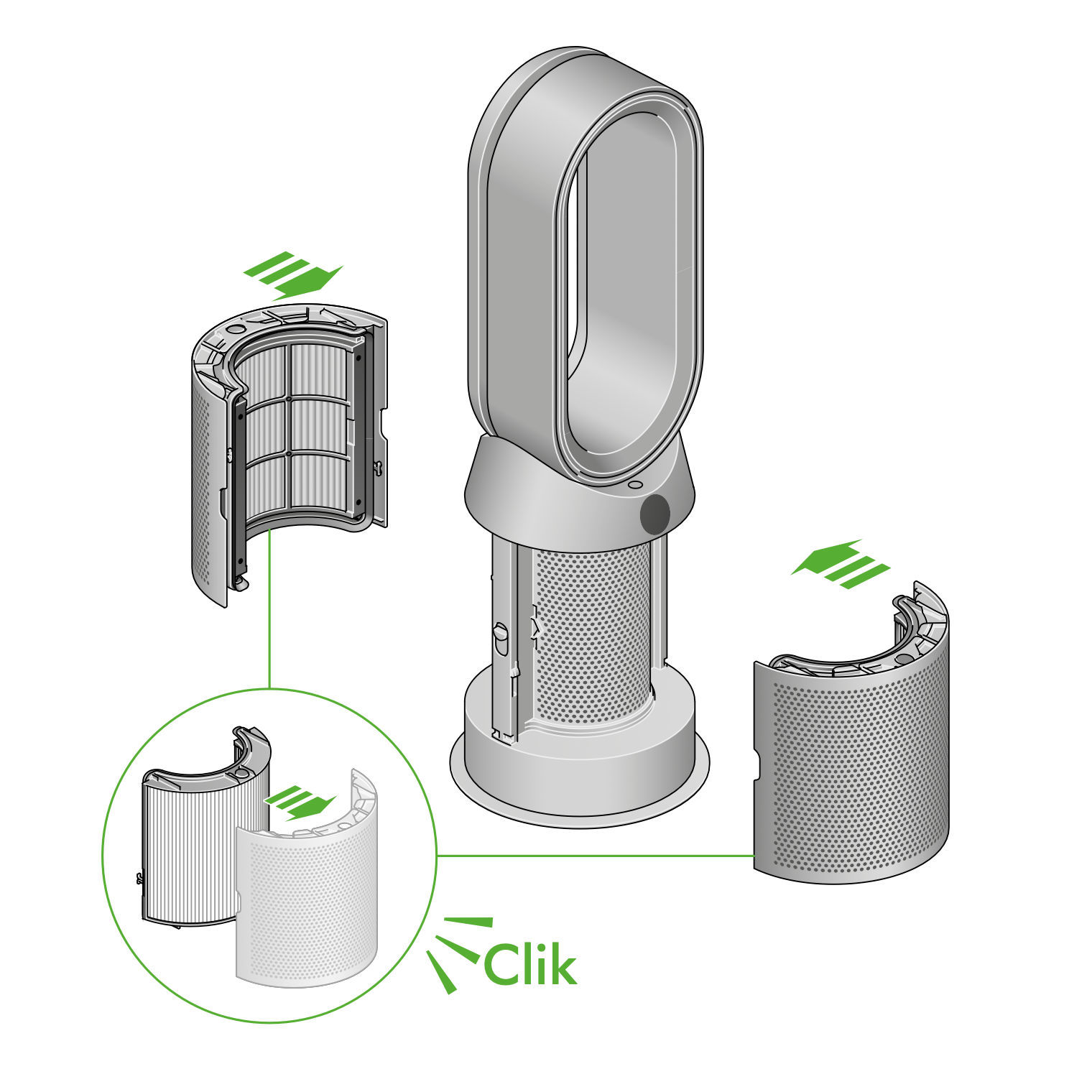
Dyson’s multi-functional models (like the Purifier Hot+Cool) leverage the same air multiplication principle while adding critical components. For purification, room air is drawn through a sealed HEPA H13 and activated carbon filter system before reaching the impeller. The filtered air then enters the amplification loop, meaning 99.95% of particles as small as 0.1 microns get entrained into the airflow. Heating models route air across a ceramic PTC (Positive Temperature Coefficient) heater in the base after filtration but before the impeller. This ensures heated air undergoes the same 15-20x amplification, creating even warmth distribution without hot spots.
Why Filtered Air Gets Amplified, Not Diluted
A common misconception is that filtering reduces airflow, but Dyson’s engineering turns this upside down. The impeller pulls air through dense filters at high pressure, ensuring thorough particle capture. Crucially, the filtered air becomes the primary jet that triggers amplification. As this clean jet travels the ring, it entrains surrounding room air—but since the fan sits in the same room, this secondary air is already being continuously purified. Within 12 minutes, Dyson’s sensors show 90% of room air passes through the filters. Pro Tip: Replace filters every 12 months—even if the fan seems fine—to maintain optimal amplification efficiency.
Preventing Common Failures: Maintenance Your Manual Doesn’t Mention
Most Dyson owners never clean the annular slit—yet this is the #1 cause of reduced performance. Dust accumulation here disrupts the Coandă effect, causing airflow separation and noise. Monthly maintenance takes 90 seconds: Unplug the unit, extend the ring to its widest angle, and use a microfiber cloth wrapped around a thin cardboard strip to wipe the inner slit surface. For stubborn buildup, a can of compressed air (held vertically to prevent moisture discharge) clears debris in seconds. Critical: Never insert metal objects—the slit’s precision edges are easily damaged. If oscillation fails, check for hair wrapped around the pivot motor in the base neck; a flashlight reveals obstructions instantly.
Why Your Dyson Shuts Off Unexpectedly (And How to Fix It)
Overheating protection triggers sudden shutdowns when air intake is restricted. Unlike traditional fans that overheat from motor strain, Dyson units typically overheat because dust blocks the base’s 360-degree intake, starving the impeller. Solution: Place the fan at least 20cm from walls (not 5cm like manuals say) and vacuum the base vents weekly. For models with air quality sensors (like TP09), false “high pollution” readings often stem from sensor dust—clean the front grille with a cotton swab monthly. Note: True overheating (blown thermal fuse) requires professional repair—don’t ignore persistent shutdowns.
The Dyson Air Multiplier isn’t just a pretty design—it’s a masterclass in fluid dynamics engineering. By replacing blade chopping with air multiplication, it delivers safer, quieter, and smoother airflow through three key stages: the hidden impeller creates a high-velocity seed jet, the Coandă effect guides this jet along the ring’s airfoil surface, and induced flow amplifies the jet 15-20x by entraining room air. Whether you’re using a basic model or a purifier variant, this core principle remains unchanged. For peak performance, commit to monthly slit cleaning and base intake vacuuming—these two actions prevent 90% of common issues. Now when you feel that bladeless breeze, you’ll know exactly how 1 liter of mechanical airflow becomes 20 liters of comfort through the invisible physics happening inside that sleek ring.
![How To Carry Dyson Air Purifier? [Best Tips]](https://dfixing.com/wp-content/uploads/2026/03/Dyson-Air-Purifier-3-1024x576.png)
![How To Change Dyson Airwrap Filter [Full Guide]](https://dfixing.com/wp-content/uploads/2026/03/Dyson-Airwrap-2-1024x576.png)